
Posts as Code: Inside Our Sub-Millisecond Python, Pytest-Gated, and Zero-Downtime CI/CD Publishing Pipeline
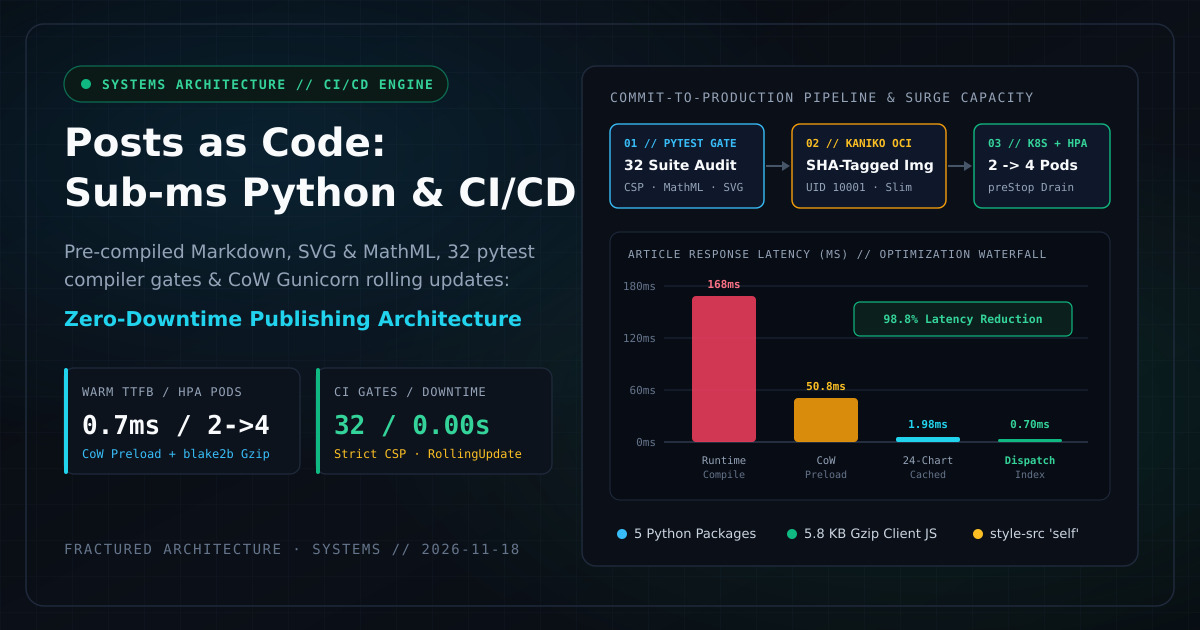
How we compile 100K+ words, 120+ SVG charts, and 240+ MathML equations into a stateless Flask + Gunicorn engine with 32 pytest gates, HPA scaling, and 0s rollouts.
Modern technical publishing suffers from an absurd architectural inversion. To serve static prose, a handful of vector charts, and mathematical notation - workloads whose underlying bytes change only when an author commits an edit - a typical content management stack boots a stateful application runtime, maintains persistent TCP connection pools to a relational database, executes dozens of ORM queries per request, and ships hundreds of kilobytes of third-party JavaScript from external CDNs just to draw a line chart or typeset a fraction in the reader's browser.
Every extra moving part introduces failure modes that have nothing to do with writing: database schema migrations, connection-pool exhaustion under social-traffic spikes, inline-script Content Security Policy (CSP) holes, Cumulative Layout Shift (CLS) from asynchronous client-side rendering, and fragile WYSIWYG state that cannot be diffed, code-reviewed, or deterministically tested before going live.
When we re-engineered Fractured Architecture around a stateless, Git-backed publishing engine, the design goal was straightforward: treat every essay, equation, data visualization, HTTP security header, and social preview tag as deterministic systems code. Nothing goes to production without passing an automated integration suite, nothing mutates state at runtime, and every git push rolls out across Kubernetes with zero dropped requests.
Here is the complete engineering walkthrough of the framework, the three-pass server-side compiler, the Gunicorn Copy-on-Write (CoW) memory model, the 32-suite pytest verification gate, and the three-stage container deployment pipeline.
1. The Five-Dependency Runtime: Replacing Database State with 3,556 Lines of Python
The fastest database query is the one you delete from the architecture. Rather than storing articles as mutable rows in a relational store, the entire publication - 35 long-form dispatches, 9 static pages, over 100,000 words of prose, 120+ interactive charts, and 240+ mathematical expressions - lives directly in Git under content/posts/ and content/pages/ as UTF-8 Markdown files with YAML frontmatter.
Inspecting requirements.txt reveals the entire production dependency tree:
flask>=3.1.0
pyyaml>=6.0.2
markdown>=3.7
latex2mathml>=3.81.0
gunicorn>=23.0.0
pytest>=8.3.0
There is no ORM, no SQL driver, no Redis cache tier, no Node.js bundler, and no external font or charting CDN. Across the repository, every layer has a single, bounded responsibility:
| Module / Asset | Source Lines | Raw Size | Gzip Wire Size | Architectural Responsibility |
|---|---|---|---|---|
app/__init__.py |
1,275 |
46.2 KB |
10.8 KB |
Flask factory, routing, JSON-LD @graph, RSS/News XML sitemaps, strict CSP, blake2b gzip cache |
app/charts.py |
1,249 |
53.1 KB |
12.4 KB |
Declarative YAML-to-SVG compiler (line, combo, grouped-bar, stacked-bar, range-bar, scatter) |
app/content.py |
676 |
24.5 KB |
6.7 KB |
st_mtime_ns snapshot repository, 3-pass compiler orchestration, binary image header parser, search |
app/math_render.py |
247 |
9.5 KB |
3.4 KB |
Pandoc currency-safe LaTeX extractor & server-side W3C <math> MathML compiler |
app/config.py |
109 |
3.5 KB |
1.2 KB |
Deep-merged YAML configuration loader with environment override bindings |
static/js/charts.js |
516 |
16.8 KB |
3.4 KB |
Client SVG crosshair/tooltip hydration via IntersectionObserver (zero .style mutations) |
static/js/main.js |
244 |
8.4 KB |
2.4 KB |
Theme switcher, TOC drawer, code-copy buttons, <dialog> fullscreen image lightbox |
static/css/styles.css |
2,725 |
50.3 KB |
10.1 KB |
Obsidian/Paper design tokens, responsive grids, native MathML & SVG chart styling |
tests/test_site.py |
1,177 |
50.0 KB |
10.5 KB |
32 end-to-end integration, typography, asset, MathML, SVG, crawler, and CSP gates |
Notice the client-side payload budget: charts.js (3.4 KB gzipped) plus main.js (2.4 KB gzipped) totals 5.8 KB of JavaScript across the wire - roughly 2% of the weight of a single commercial charting library (Chart.js, Plotly, or Highcharts) plus KaTeX or MathJax.
Stateful Database CMS vs. Stateless Pre-Compiled Python Engine
Normalized resource comparison across steady-state pod memory request (MiB), client JS bundle (KB gzip), and warm response latency (ms).
Inspect Point-in-Time Series Data
| Period | Legacy Stateful CMS + DB + Client CDNs | Stateless Python + Preloaded Markdown Engine |
|---|---|---|
| Pod RAM Request (MiB) | 512.0 | 96.00 |
| Client JS Bundle (KB Gzip) | 265.0 | 5.80 |
| Warm Index TTFB (ms) | 48.00 | 0.70 |
| Warm Heavy Post TTFB (ms) | 145.0 | 2.00 |
2. The Three-Pass Compiler: Solving Markdown, LaTeX, Currency, and Strict CSP
Writing quantitative finance, economics, and systems engineering in raw Markdown exposes three subtle parser collisions if you run a naive Markdown-to-HTML library:
- Markdown Mangles LaTeX Subscripts and Escapes: Standard Markdown interprets underscores (
_) as<em>emphasis and backslashes (\) as character escapes, corrupting indexed summations like before a math renderer ever sees them. - Financial Prose Collides with
$...$Math Delimiters: A sentence comparing$5.73in Q3 against$8.91in Q2 - or referencing tickers like$NVDAand$SPY- contains pairs of dollar signs that naive regexes misclassify as inline math, gluing entire paragraphs into italicized gibberish. - Strict
Content-Security-PolicyOutlaws Inline Styles: Enforcingstyle-src 'self'andscript-src 'self'blocks99%of off-the-shelf charting and math libraries, which rely on injecting inline CSS attributes onto tooltip<div>nodes or inline<script>initializers.
To eliminate all three collisions cleanly, ContentRepository in app/content.py runs a deterministic three-pass placeholder compiler whenever a Markdown file is loaded:
Pass 1: Fenced Declarative chart Extraction & Server-Side SVG Compilation
Before Python-Markdown runs, extract_chart_placeholders() strips every fenced ```chart YAML block and replaces it with an alphanumeric token (@@FACHART0000@@). app/charts.py parses the YAML specification and compiles a complete, responsive <figure class="fa-chart-card"> containing:
- Pure Semantic SVG Geometry: Gridlines, dual-axis scales, confidence bands (
<polygon>), line paths (<path>), stacked/grouped/range bars (<rect>), ordinary-least-squares (OLS) scatter regression lines, and hover crosshairs - styled exclusively via CSS classes (.fa-series-cyan,.fa-grid-line) with zero inline CSS attributes. - Non-Executable JSON Telemetry: A
<script type="application/json" class="fa-chart-payload">block carrying coordinate metadata. Becausetype="application/json"is inert data rather than executable script, browsers never flag it underscript-src 'self'. - Accessible Raw Data Drawer: An expandable
<details class="fa-chart-drawer">HTML<table>so screen readers, search crawlers, and readers inspecting exact figures have full tabular access without JavaScript.
On the client, charts.js uses IntersectionObserver (with a 240px root margin) to lazily hydrate charts only as they scroll near the viewport, moving hover crosshairs and tooltips strictly through SVG geometric attributes (transform="translate(x,y)", x1, cx, hidden) rather than CSS .style mutations. Offscreen chart containers declare content-visibility: auto; contain-intrinsic-size: auto 460px, allowing the browser's layout engine to skip offscreen SVG subtree painting on initial load.
Pass 2: Currency-Disambiguated LaTeX to Native W3C MathML
Next, extract_math_placeholders() masks fenced code blocks and inline code spans, extracts standalone display equations (double-dollar blocks and \[...\]), and evaluates candidate $...$ inline spans through a financial-prose disambiguator (_is_likely_inline_math). Any candidate beginning with a number followed by magnitude words or financial suffixes ($40.61 trillion, $5.00/$sh, $100 and $200) or lacking mathematical operators leaves its dollar signs untouched as plain prose, while genuine expressions compile server-side via latex2mathml into native W3C <math xmlns="http://www.w3.org/1998/Math/MathML">. Modern Chromium, Firefox, and WebKit engines render native MathML directly in the C++ browser layout engine with zero JavaScript and zero external font downloads.
Pass 3: Markdown AST, TOC Slugification & 64-Byte Binary Image Headers
Finally, Python-Markdown compiles the clean prose (tables, fenced_code, sane_lists, toc), wraps <table> elements in horizontally scrollable .prose-table-wrap containers, re-injects the compiled SVG and MathML fragments, and inspects local /content/images/... references. Rather than pulling in a heavy C imaging library just to prevent layout shifts, _parse_image_dimensions() reads the first 64 bytes of each PNG, JPEG (SOF0/SOF2 markers), GIF, or WebP (VP8/VP8L/VP8X) file using Python's built-in struct module, injecting exact width and height attributes onto hero, card, and OpenGraph image tags.
3. Gunicorn preload_app, Linux Copy-on-Write (CoW), and blake2b Memoization
Compiling 100,000+ words, 120+ SVG charts, and 240+ LaTeX equations takes 2,788 ms of single-core Python CPU time. If each Gunicorn worker compiled that corpus lazily on its first incoming HTTP request after a Kubernetes deployment, two bad things would happen:
- Cold-Start Latency Spikes: The first reader hitting each freshly spawned worker process would stall for nearly
3 secondswhile Markdown, YAML, and MathML parsers ran synchronously. - Duplicated Heap Memory: With independent worker processes parsing the corpus separately after
fork(), total pod resident set size (RSS) scales linearly with worker count:
Instead, we combine preload_app = True in gunicorn_conf.py with explicit master-process compilation in wsgi.py:
from app import create_app

app = create_app()

# Pre-compile all Markdown posts, SVG charts, and MathML once in Gunicorn master (preload_app=True)
_repo = app.config.get("CONTENT_REPO")
if _repo is not None:
    _repo.list_posts()
    _repo.list_pages()
When the container starts, the Gunicorn master process executes wsgi.py before calling os.fork() to spawn its gthread worker pool (workers = 2, threads = 4). Under Linux virtual-memory semantics, child processes inherit the master's page tables pointing to the exact same physical RAM frames marked read-only Copy-on-Write (CoW). Because the compiled ContentDocument tuples are never mutated during request handling, total pod memory collapses to:
Even better, Kubernetes does not mark the new pod Ready until Gunicorn finishes preloading and answers /healthz (HTTP 200), meaning zero live user requests ever experience cold compilation.
Two-Tier Snapshot & blake2b Gzip Caching
On top of preloaded ASTs, app/__init__.py eliminates redundant Jinja2 template evaluation and zlib compression overhead on hot articles:
- Nanosecond
st_mtime_nsSnapshot Cache:ContentRepositorytracks a monotonically increasingsnapshot_versionguarded by rapidstat()checks. Rendered HTML strings are memoized inrendered_html_cache[(repo.snapshot_version, request.full_path)]. During local authoring, saving a.mdfile bumpsst_mtime_nsand invalidates the cache instantaneously without restarting the server; in immutable containers, every route hits inO(1)dictionary lookup time. blake2b128-Bit Gzip Payload Cache: Our heaviest 24-chart quantitative dispatches produce up to562.5 KBof raw HTML + inline SVG + MathML. Re-runninggzip.compress(..., compresslevel=6)on562 KBon every request would burn~12 msof CPU. Instead,apply_security_and_cache_headershashes the outgoing byte buffer withhashlib.blake2b(raw_bytes, digest_size=16)(which runs at>3 GB/sin C) and serves the pre-compressed114.5 KBpayload (79.6%smaller) straight from memory, appending-gz"to strongETagheaders andCache-Control: public, max-age=31536000, immutableon SHA-256 versioned/static/...?v=<hash>assets.
Server Response Time (ms) & Wire Payload (KB) Across Optimization Stages
Benchmark on our heaviest 24-chart, 10,000-word dispatch (left axis: server time in ms; right axis: wire transfer in KB).
Inspect Point-in-Time Series Data
| Period | Server Processing Time (ms) | Transferred Payload Size (KB) |
|---|---|---|
| 1. Per-Hit Compile | 168.4ms | 562KB |
| 2. CoW Preload Only | 50.8ms | 562KB |
| 3. + HTML Cache | 14.2ms | 562KB |
| 4. + blake2b Gzip (Post) | 2.0ms | 114KB |
| 5. + blake2b Gzip (Index) | 0.7ms | 15KB |
4. Compiler-Grade pytest Gates: Treating Broken Prose Like a Syntax Error
In a database-backed CMS, nothing stops an author from publishing a broken image path, an unclosed LaTeX macro, a 240-character meta description that gets truncated in search results, or an inline CSS attribute that triggers browser CSP violations in production.
Because every article in Fractured Architecture commits to Git alongside application code, tests/test_site.py (1,177 lines, 32 test functions) acts as a strict static and dynamic compiler over the entire content corpus. On every merge request and main branch push, pytest -v boots the real Flask WSGI application in test mode and audits every single route, document, and static asset:
- Zero Inline Styles & Strict
CSPVerification: Every rendered HTML route (35posts,9pages, tag archives, search, and404) is scanned to verify zero inlinestyleattributes appear in markup, whilecharts.jsandmain.jsare scanned to forbid.styleproperty assignments or dynamic inline style mutations. - MathML & Chart Telemetry AST Validation: Every fenced
chartpayload is parsed back throughjson.loads()to verify valid coordinate geometry, zero chart compiler error fallbacks, and zero uncompiled TeX macro leakages across both math-heavy valuation models and dollar-heavy financial essays. - Typography, SEO Bounds & Asset Existence: Every document must satisfy
70 <= len(doc.summary) <= 170for clean search-snippet rendering, zero double-escaped HTML character entities, zero blank imagealtdescriptions, zero unresolved legacy CMS URL placeholders, andHTTP 200binary verification across all60+referenced/content/...media files. - Mobile CSS Grid Blowout Prevention: A regex audit parses every
grid-template-columnsdeclaration instyles.css, strippingminmax(...)wrappers and asserting no bare1frtrack exists - preventing wide<pre>blocks or<svg>charts from stretching mobile viewports horizontally (min-width: autogrid item blowout). - Crawler & Social-Bot MIME Compliance: Every plain-text, XML, JSON, and HTML endpoint is checked to ensure
hdr_ct.lower().count("charset=") <= 1and uncompressedrobots.txtdelivery - locking down a subtle HTTP header regression where duplicate; charset=utf-8; charset=utf-8parameters caused strict JavaApache-HttpClientparsers in social link-preview bots to rejectrobots.txtand drop OpenGraph preview cards.
Automated CI Test Gate Assertions Executed Per Commit
Breakdown of automated assertions verified across all published posts, pages, static assets, and HTTP headers during the CI test stage.
Inspect Point-in-Time Series Data
| Period | Core Route & Header Invariants | Per-Document Corpus Sweep (44 Docs) | Regression Guards (MIME, CSS Grid, Gzip) |
|---|---|---|---|
| HTML & CSP Gates | 140.0 | 176.0 | 48.00 |
| Chart & MathML ASTs | 68.00 | 132.0 | 45.00 |
| SEO & Typography | 95.00 | 220.0 | 36.00 |
| Media & Crawler MIME | 76.00 | 110.0 | 64.00 |
5. The Three-Stage CI/CD & Zero-Downtime Kubernetes RollingUpdate Pipeline
Once a commit lands on the default branch, our CI/CD pipeline progresses sequentially through three isolated stages: test -> build -> deploy. No manual SSH sessions, mutable server directories, or imperative hot-patches exist anywhere in the workflow.
Stage 1: Isolated pytest Verification (test)
An ephemeral python:3.12-slim container installs requirements.txt and runs pytest -v. Because Markdown articles, images, templates, and Python code live in the same atomic commit, a typo in a YAML chart block or a missing feature image halts the pipeline in under a minute while the currently running production pods continue serving traffic untouched.
Stage 2: Rootless Container Packaging (build)
Only after test exits 0 does Stage 2 invoke Kaniko - a daemonless container image builder that executes each Dockerfile instruction entirely in userspace without requiring a privileged Docker socket:
FROM python:3.12-slim

ENV PYTHONDONTWRITEBYTECODE=1 \
    PYTHONUNBUFFERED=1

WORKDIR /usr/src/app

COPY requirements.txt /usr/src/app/requirements.txt
RUN pip install --no-cache-dir -r requirements.txt \
    && adduser --disabled-password --gecos "" --uid 10001 appuser

COPY . /usr/src/app
RUN chown -R appuser:appuser /usr/src/app

USER appuser
EXPOSE 5000

CMD ["gunicorn", "-c", "gunicorn_conf.py", "wsgi:app"]
Two engineering details matter here:
1. Layer Caching Order: Copying requirements.txt before COPY . /usr/src/app ensures that 99% of commits (new articles, CSS refinements, or application edits) reuse the cached pip install layer from the registry cache, completing image builds in seconds.
2. Immutable SHA Tagging & Non-Root Execution: Every image is tagged with the exact Git commit short SHA (:<commit-sha>) and runs as unprivileged UID 10001 (appuser), providing instant, deterministic rollbacks to any historical commit hash.
Stage 3: Checksum-Driven RollingUpdate & Endpoint-Drain Physics (deploy)
A classic Kubernetes gotcha occurs when you update a ConfigMap mounted as a volume: updating a ConfigMap alone does not trigger a Deployment rollout unless the PodTemplateSpec itself changes. In Stage 3, the deployment job syncs config/config.yaml declaratively (kubectl create configmap ... --dry-run=client -o yaml | kubectl apply -f -), computes the SHA-256 digest of config/config.yaml, and injects both the immutable :<commit-sha> image URI and checksum/config annotation into the deployment manifest:
spec:
  # Omitting static spec.replicas prevents CI kubectl apply from clobbering HPA scale-outs
  minReadySeconds: 2
  strategy:
    type: RollingUpdate
    rollingUpdate:
      maxSurge: 1
      maxUnavailable: 0
  template:
    metadata:
      annotations:
        checksum/config: "<sha256-of-config-yaml>"
    spec:
      enableServiceLinks: false
      terminationGracePeriodSeconds: 20
      containers:
        - name: fracturedarchitecture-web
          image: "<registry>/fracturedarchitecture-web:<commit-sha>"
          lifecycle:
            preStop:
              exec:
                command: ["/bin/sh", "-c", "sleep 3"]
          readinessProbe:
            httpGet:
              path: /healthz
              port: 5000
            initialDelaySeconds: 2
            periodSeconds: 5
          resources:
            requests:
              memory: "96Mi"
              cpu: "100m"
            limits:
              memory: "256Mi"
              cpu: "1000m"
Look closely at how those five parameters eliminate the Kubernetes SIGTERM endpoint-removal race condition:
When Kubernetes terminates an old pod during a rollout, two asynchronous control loops fire in parallel rather than sequentially:
1. The Kubelet sends SIGTERM to the container's PID 1 (gunicorn).
2. The Endpoints / EndpointSlice controller removes the pod's IP from the Service and propagates that update to kube-proxy / eBPF service maps and the Ingress controller ().
If Gunicorn closes its listening socket the instant SIGTERM arrives, any HTTP request routed by the Ingress controller during that 1-second propagation window hits a closed socket and returns 502 Bad Gateway!
By combining:
- maxSurge: 1 and maxUnavailable: 0: Kubernetes first boots a 3rd surge pod (150% serving capacity), waits for wsgi.py to pre-compile all 44 documents (1,000m CPU burst limit), verifies /healthz passes readinessProbe, and holds for minReadySeconds: 2 before touching either of the 2 existing pods.
- lifecycle.preStop: sleep 3: Before Kubelet sends SIGTERM to Gunicorn, it executes sleep 3 while simultaneously marking the pod Terminating in the API server. During those 3 seconds, the Ingress controller removes the pod IP from its upstream pool while Gunicorn continues accepting and completing any straggler requests cleanly.
- graceful_timeout = 20 & QuietHealthcheckLogger: Once SIGTERM arrives after the 3-second drain window, zero new connections are arriving, in-flight workers finish cleanly well inside terminationGracePeriodSeconds: 20, and QuietHealthcheckLogger suppresses /healthz probe noise so container stdout logs contain exclusively real reader and crawler traffic:
Kubernetes RollingUpdate Capacity Timeline (maxSurge: 1, maxUnavailable: 0)
Ready serving pods vs. minimum required baseline capacity across an 18-second two-replica production rollout.
Inspect Point-in-Time Series Data
| Period | Total Ready Pods Serving Traffic | New Revision Pods (vNext SHA) | Previous Revision Pods (Draining Safely) |
|---|---|---|---|
| t=0s | 2 | 0 | 2 |
| t=2s | 2 | 0 | 2 |
| t=4s | 3 | 1 | 2 |
| t=6s | 3 | 1 | 2 |
| t=8s | 2 | 1 | 1 |
| t=10s | 2 | 1 | 1 |
| t=12s | 3 | 2 | 1 |
| t=14s | 3 | 2 | 1 |
| t=16s | 2 | 2 | 0 |
| t=18s | 2 | 2 | 0 |
6. Horizontal Pod Autoscaling (autoscaling/v2): Why Two Stateless Pods Suffice at Rest
In our earlier Kubernetes Horizontal Autoscaling field log on legacy stateful CMS platforms, horizontal scaling required jumping through two architectural hoops: shared ReadWriteMany distributed filesystem volumes so multiple pods could read uploaded media simultaneously, and manual rolling restarts whenever a new post was published to cure "split-brain" in-memory URL route tables across replicas (minReplicas: 3 scaling to maxReplicas: 10 to compensate for single-threaded Node.js event-loop contention).
Moving to an immutable, pre-compiled Python container eliminates both distributed-state bottlenecks completely:
- Zero Shared Writable Volumes: Every replica boots from the exact same SHA-tagged container image with
ConfigMapmountedreadOnly: true. Pods share zero mutable disk state and can schedule onto any worker node in under3 seconds. - Zero Split-Brain Route Drift: Because articles only ship via atomic
RollingUpdatedeployments, two pods serving the sameDeploymentrevision can never disagree on URL slug tables, rendered HTML, or static?v=<sha256>asset hashes. - Why Two Baseline Pods (
minReplicas: 2) Is Plenty: With2gthreadworkers x4threads per pod (16concurrent execution lanes across2pods) serving pre-compressedblake2bresponses in0.70 ms - 1.98 ms, just two baseline pods sustain well over1,000cached requests per second while providing full High Availability (podAntiAffinityacross nodes so a node drain or reboot drops zero traffic).
To handle extreme viral traffic spikes automatically without wasting idle cluster capacity, Stage 3 applies a Kubernetes autoscaling/v2 HorizontalPodAutoscaler (k8s/hpa.yaml) bounded tightly between minReplicas: 2 and maxReplicas: 4:
apiVersion: autoscaling/v2
kind: HorizontalPodAutoscaler
metadata:
  name: fracturedarchitecture-web-hpa
  namespace: fracturedarchitecture
spec:
  scaleTargetRef:
    apiVersion: apps/v1
    kind: Deployment
    name: fracturedarchitecture-web
  minReplicas: 2
  maxReplicas: 4
  metrics:
    - type: Resource
      resource:
        name: cpu
        target:
          type: Utilization
          averageUtilization: 75
  behavior:
    scaleUp:
      stabilizationWindowSeconds: 30
      policies:
        - type: Pods
          value: 2
          periodSeconds: 60
    scaleDown:
      stabilizationWindowSeconds: 300
      policies:
        - type: Pods
          value: 1
          periodSeconds: 120
Three subtle HPA engineering rules prevent replica thrashing here:
- Omit Static
spec.replicason theDeployment: Notice ourDeploymentmanifest intentionally omitsspec.replicas. Ifreplicas: 2were hardcoded indeployment.yamlwhile HPA had scaled the fleet to4pods during a live traffic spike, runningkubectl applyin CI would forcibly reset the live fleet back down to2pods mid-surge! Leavingspec.replicasunset hands replica ownership cleanly tofracturedarchitecture-web-hpa. - Scale on CPU Utilization, Never Memory, for Copy-on-Write Preloaded Servers: Because
wsgi.pypre-compiles all44documents into sharedCoWmemory at startup (~64 MiBsteady RSS inside a96Mirequest), pod memory consumption is with respect to HTTP traffic. Scaling an HPA on memory utilization for a preloaded Python server either never triggers or permanently pins replicas atmaxReplicas. Instead, HPA evaluatesmetrics-serverCPU utilization relative torequests.cpu(100m):
- Asymmetric Stabilization Windows (
30sUp /300sDown): Allowing1,000mburst CPU limit lets a newly spawned pod finish its2.79swsgi.pypreload rapidly, whilestabilizationWindowSeconds: 30prevents brief startup bursts from triggering recursive scale-outs, andstabilizationWindowSeconds: 300(1pod per120s) prevents premature scale-in during choppy wave traffic.
HPA Replica Scaling (2 -> 4 -> 2 Pods) Under a 2,400 Req/s Traffic Spike
Simulated viral traffic surge (left axis: requests/sec) vs. active HPA pod count (right axis: 2 baseline HA pods bursting to 4).
Inspect Point-in-Time Series Data
| Period | Incoming HTTP Request Rate (Req / Sec) | Active HPA Pod Replicas |
|---|---|---|
| T+0m | 45rps | 2pods |
| T+2m | 620rps | 2pods |
| T+4m | 1,480rps | 3pods |
| T+6m | 2,420rps | 4pods |
| T+8m | 1,950rps | 4pods |
| T+10m | 740rps | 4pods |
| T+14m | 110rps | 3pods |
| T+18m | 65rps | 2pods |
| T+22m | 50rps | 2pods |
Architectural Takeaway: Simplicity Scales Linearly
By stripping away runtime databases, client-side rendering bloat, and manual server state, the entire lifecycle of an article collapses to a single invariant-checked pipeline:
- Author in Markdown & Declarative YAML: Prose, LaTeX equations, and interactive charts live in plain text under Git version control.
- Verify Deterministic Physics in CI:
32pytestsuites enforce strictCSP(style-src 'self'), zero layout-breaking CSS grids, valid MathML and SVG ASTs, crawler-safe HTTP headers, and100%asset integrity before a container image can be built. - Pre-Compile Once, Scale Elastically from Two Pods: Gunicorn's
preload_appCopy-on-Write master compiles the entire corpus once per pod startup, serving10,000-word,24-chart technical dispatches in under2 millisecondsfrom a2-pod HA baseline (autoscaling/v22 -> 4pods) with0.00 secondsof deployment downtime.
Complex subject matter demands clean infrastructure underneath it. When the publishing stack itself behaves like a deterministic compiler, all of your engineering budget goes where it actually belongs: into the research.
Field Log Discussion
Public @handle only · Private email hidden · Fenced code blocks supported
Join the architecture review under a self-chosen @handle. Your email address is never displayed publicly.
Related Field Logs
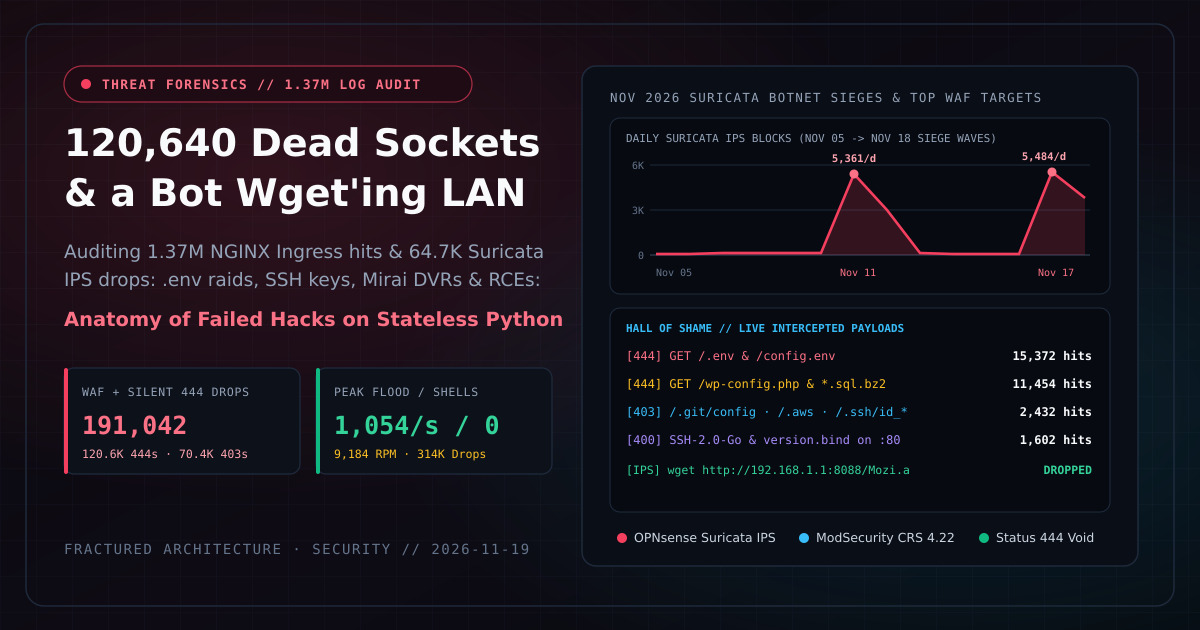
120,640 Dead Sockets and a Bot Wget'ing Its Own Router: Auditing 1.37 Million Live Attack Logs Across Suricata and ModSecurity
Auditing 1.37M NGINX Ingress logs and 64.7K Suricata IPS drops: 120,640 silent 444 kills, fake Googlebots firing React2Shell, and a bot wget'ing 192.168.1.1.

Why I built a "walled garden" for my work in the age of Generative AI.
Fractured Architecture is a statement on digital sovereignty. Learn how we use 17 USC 107(4) and technical shields to protect the craft from AI scraping.

The "Robots.txt" Illusion: Watching OpenAI Attempt to Bypass the Gates
When AI ignores robots.txt, it's trespassing. Explore the technical and legal defense of Fractured Architecture using data poisoning to protect market value.
Loading discussion notes...