
The "Robots.txt" Illusion: Watching OpenAI Attempt to Bypass the Gates
When AI ignores robots.txt, it's trespassing. Explore the technical and legal defense of Fractured Architecture using data poisoning to protect market value.
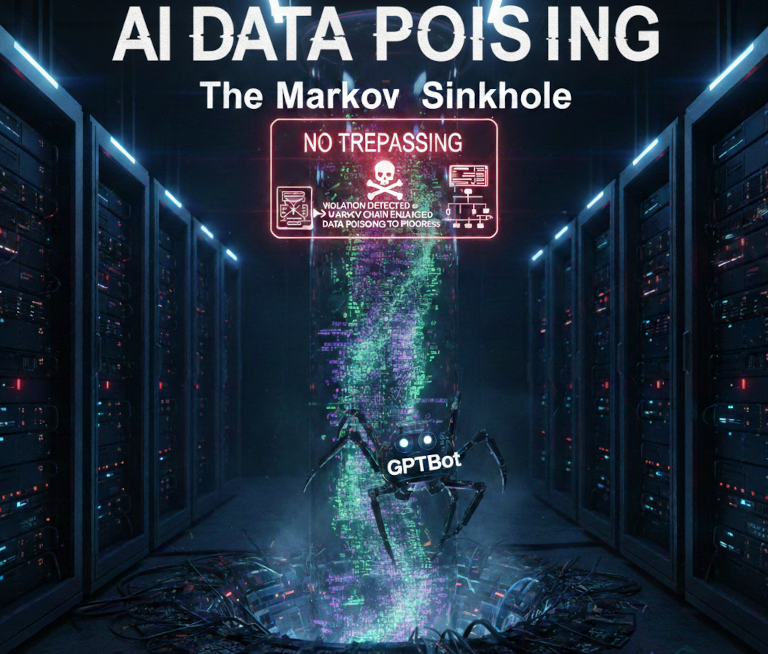
I’ve always viewed robots.txt as a gentleman’s agreement, a polite "no trespassing" sign for the web. But as my latest Nginx logs show, some bots are more "gentlemanly" than others.
While monitoring the stack this morning, I caught a flurry of 444 Connection Closed responses triggered by my ModSecurity rules. The culprit? OpenAI.
The "Polite" Request
For reference, here is what I’m serving at fracturedarchitecture.com/robots.txt. It’s simple, explicit, and follows standard conventions:
User-agent: GPTBot
Disallow: /

User-agent: ChatGPT-User
Disallow: /

User-agent: *
Disallow: /ghost/
Disallow: /p/
I’ve explicitly told GPTBot (the crawler) and ChatGPT-User (the browsing tool) that the entire site is off-limits. Yet, the logs tell a different story. OpenAI is not even looking for ai.txt which I plan to add in the future in case they decide to follow that standard. Ai.txt is a bit of the wild west at the moment.
The Logs Don’t Lie
I noticed two distinct behaviors from the OpenAI infrastructure hitting the server:
- GPTBot (The Crawler): Despite the explicit
Disallow: /above, it was still knocking on the door of my/content/images/directory. - ChatGPT-User (The Proxy): This one is even more aggressive. Because it’s often triggered by a specific user request to "browse the web," it frequently ignores robots exclusion entirely, acting more like a manual browser than a crawler.
A Note on "User-Initiated" Browsing
OpenAI’s justification for ChatGPT-User ignoring robots.txt is that it’s acting as a proxy for a human user. I don’t care. A user’s desire to "summarize" my content via a third-party tool does not override my server’s access policy. My infrastructure is my property, and my policy is a boundary, not a suggestion. Whether a bot is crawling for general training or acting as a proxy for a single person, if it ignores my robots.txt and attempts to bypass my WAF, it is a trespasser. My stack doesn't check for "intent" it only checks for compliance.
Legal Grounding: 17 U.S.C. § 107(4)
This isn't just a preference; it's a defense of intellectual property. Under 17 U.S.C. § 107(4), a core factor of Fair Use is the** "effect of the use upon the potential market for or value of the copyrighted work."** When a bot acts as a** market substitute **delivering my content’s value inside its own interface so a user doesn't have to visit my site it is no longer "Fair Use." It is a market replacement.
Note: I am not a lawyer. This is a technical interpretation of how I protect my own infrastructure.
Why My WAF Won Where the Text File Failed
If I had relied solely on robots.txt, these hits would have reached the Ghost backend, consuming resources and scraping content for training data. Instead, my Nginx/ModSecurity config caught them at Phase 1:
[msg "Blocked Marketing/AI Bot: Mozilla/5.0 ... GPTBot/1.3"] [id "10008"]
Next Step: Data Poisoning
Blocking is fine, but it’s passive and boring. My next plan is to move from defense to active "counter-intelligence."
If a bot ignores the robots.txt I’m planning to route them into a Markov Chain sinkhole. Instead of a 444 or a 403, the server will serve procedurally generated, syntactically correct, but logically nonsensical "technical articles."
By feeding the crawlers a steady diet of high-entropy garbage data, I can effectively poison the local weights of any model attempting to ingest this site without permission. If they want to scrape the "Fractured" architecture, I might as well give them something truly fractured.
Next Steps & Implementation
I am currently working on the backend logic for the Markov Sinkhole. Once the implementation is stable and I've verified that it's successfully serving "garbage" to the offending User-Agents without affecting real site performance, I will post a follow-up article.
I’ll be providing the full source code and the specific Nginx/ModSecurity configuration rules so you can deploy your own "bot trap" on your self-hosted stacks.
Credit where it's due
This concept of "data poisoning" as a defensive measure isn't just theory. I want to give credit to the researchers behind Nightshade and** Glaze** (University of Chicago), whose work on "adversarial examples" for generative AI proved that you can effectively fight back against unauthorized scraping by making the data toxic to the model's latent space.
The Takeaway
In 2026, robots.txt is basically security theater for AI. If you actually want to control who (or what) is ingesting your data, you have to enforce it at the firewall level or better yet, feed the machine something that makes it sick. By the way you may notice the cover of this post is AI generated. Notice if it made any mistakes?
Banning Smart Bots with NGINX ModSecurity Agenda * Who is on the Blocklist? * The SEO Giants (Ahrefs, Semrush, Moz) * The AI Scrapers (GPTBot, ClaudeBot, Bytespider) * Taking it a Step Further: The Layer 3 Ban * Automating the ban from NGINX logs to OPNsense Firewall * Robots.txt Configuration * Offensive Defense: Poisoning the Well * The “Gibberish” Redirect strategy * The Inspiration:
Field Log Discussion
Public @handle only · Private email hidden · Fenced code blocks supported
Join the architecture review under a self-chosen @handle. Your email address is never displayed publicly.
Related Field Logs
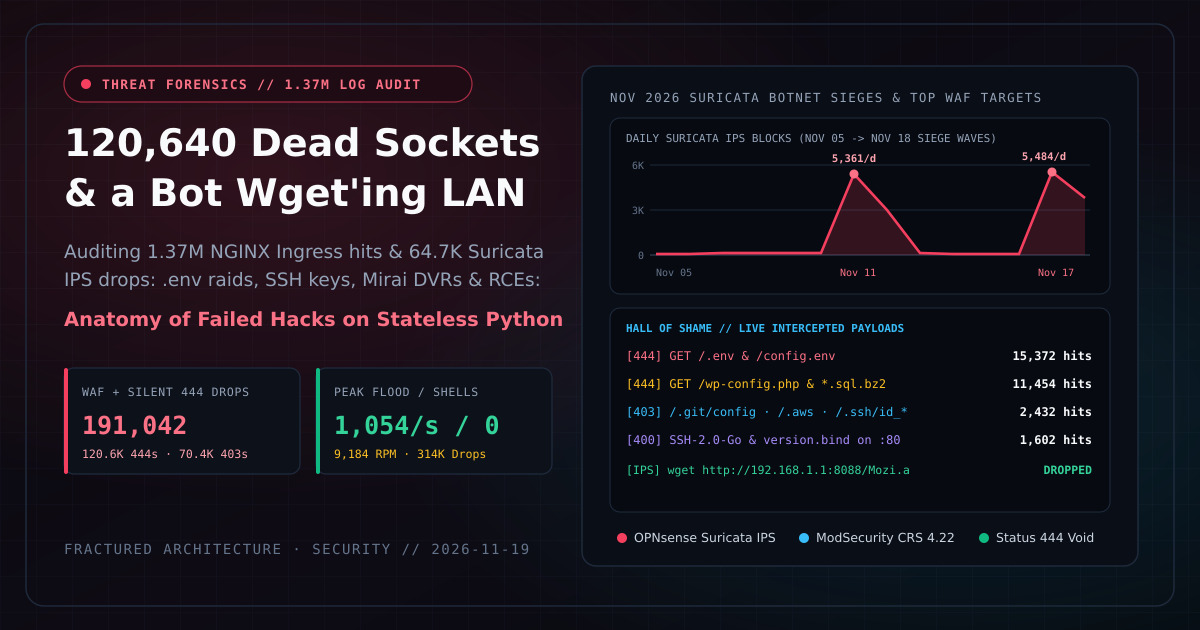
120,640 Dead Sockets and a Bot Wget'ing Its Own Router: Auditing 1.37 Million Live Attack Logs Across Suricata and ModSecurity
Auditing 1.37M NGINX Ingress logs and 64.7K Suricata IPS drops: 120,640 silent 444 kills, fake Googlebots firing React2Shell, and a bot wget'ing 192.168.1.1.
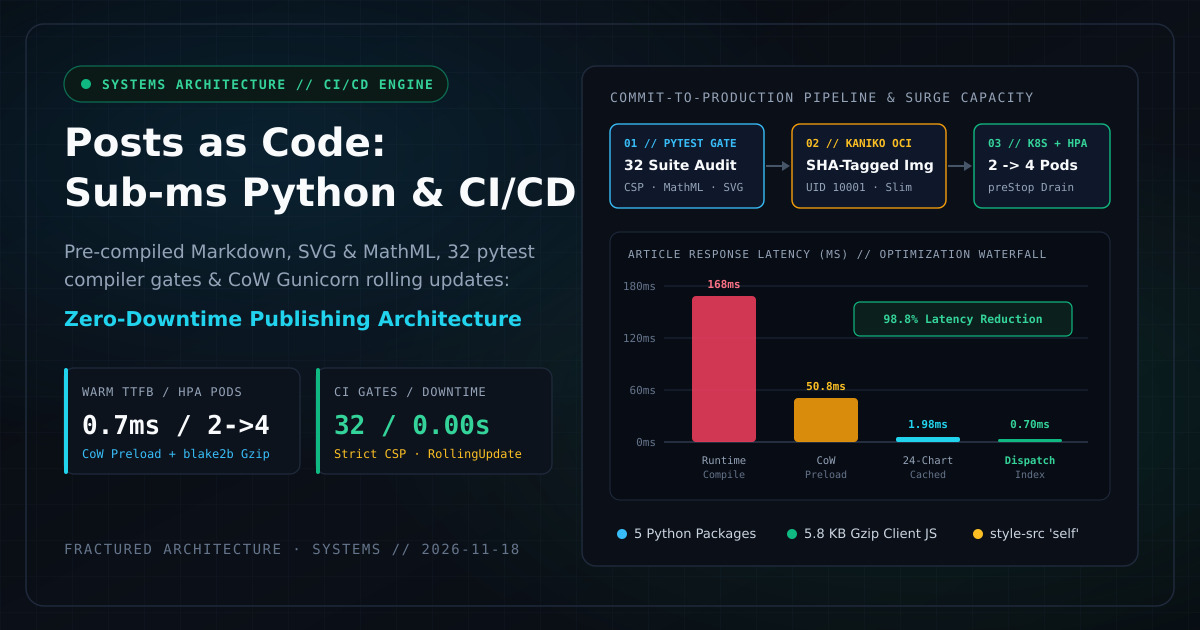
Posts as Code: Inside Our Sub-Millisecond Python, Pytest-Gated, and Zero-Downtime CI/CD Publishing Pipeline
How we compile 100K+ words, 120+ SVG charts, and 240+ MathML equations into a stateless Flask + Gunicorn engine with 32 pytest gates, HPA scaling, and 0s rollouts.

Why I built a "walled garden" for my work in the age of Generative AI.
Fractured Architecture is a statement on digital sovereignty. Learn how we use 17 USC 107(4) and technical shields to protect the craft from AI scraping.
Loading discussion notes...