
Is AI an existential threat to Open Source?
How LLM code harvesting, the information bottleneck, and 17 U.S.C. 107 fair-use limits pressure engineers to move open-source work private.
- The Historical Analogue: Calculation vs. Conceptualization
- The Myth of the Digital Utopia: The Hunter-Gatherer Clan
- The Parasitic Expansion: Architects and the Crumbling Base
- The Rise of the Private Fortress: Hoarding the Secret Sauce
- The SaaS Liquidation: A Warning from Recent News
- The Intellectual Property Standoff: Fair Use & 17 U.S.C. § 107
- The Information Bottleneck: Speed vs. Substance
- The Biological Pivot: Physical AI Robots as Apex Competitors
- The Paradox of the Mirror: Conclusion
The relationship between Artificial Intelligence and Open Source Software (OSS) is currently caught in a paradox. On one hand, AI is the ultimate "power-up" for developers; on the other, it feels like a potential "game over" screen for the traditional OSS ecosystem. As Large Language Models (LLMs) become the primary interface for writing code, we have to ask: Is AI a collaborative partner, or is it a "black hole" that consumes and will eventually replace open-source logic for a fee?
The Historical Analogue: Calculation and Conceptualization
To understand this shift, we often look to a historical analogue in the field of mathematics. The evolution of mathematical output has always been defined by the tools that offloaded the "cognitive overhead" of raw calculation, allowing the human mind to focus on high-level abstraction.
The introduction of the electronic calculator acted as the first major catalyst, liberating mathematicians from the grueling, error-prone manual arithmetic that historically consumed hours of mental energy. This shift moved the bottleneck from computation to conceptualization.
The Exponential Leap of Programmable Logic
The transition to programmable computers triggered a true exponential leap. Computers did not just speed up arithmetic; they introduced entirely new methodologies like Monte Carlo simulations, numerical analysis, and the ability to verify massive combinatorial proofs (such as the Four Color Theorem) that are humanly impossible to check by hand.
This "calculative freedom" allowed for a rapid rise in output because it transformed mathematics from a purely deductive pursuit into an experimental science, where hypotheses can be tested against billions of data points in seconds. While these tools expanded the field, they remained tools. The human mathematician remained the pilot. AI, however, is beginning to act as the pilot itself.
The Myth of the Digital Utopia
Parasitic Expansion
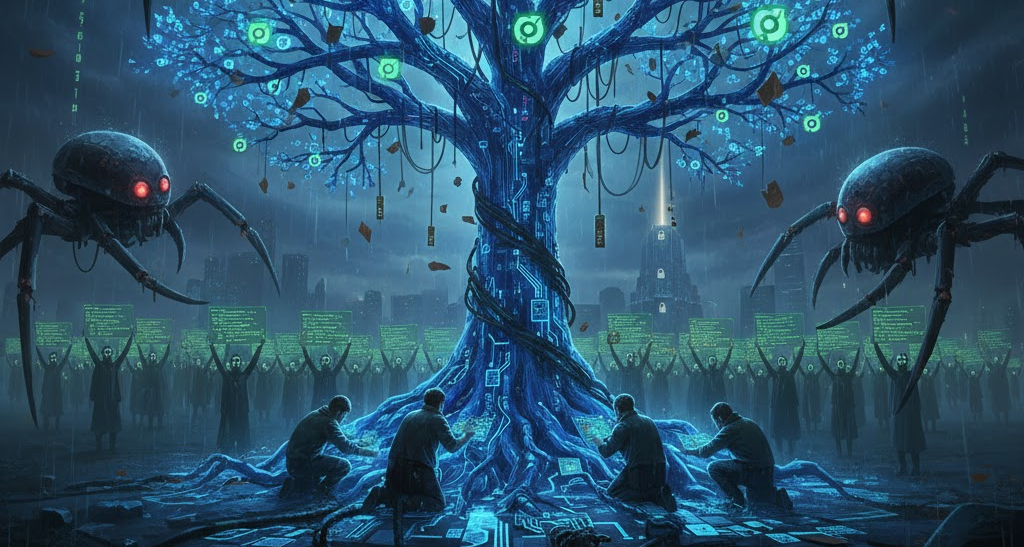
We often mistake Open Source for a global utopia, but at its heart, it was a digital version of the "hunter-gatherer" clan. This was a group of people sharing tools and knowledge to ensure the collective survival of the project. AI has turned this communal sharing into a liability.
In a world where there is a fixed ceiling on the amount of work needed for a population, AI acts as a "hyper-contributor." If one person using AI can fulfill the needs of the entire clan, the other members face social and economic extinction. The scarcity is no longer the code itself, but the available slots for those who write it.
The Parasitic Expansion: Architects and the Crumbling Base
We are currently witnessing a massive expansion in the number of people "writing" code, but this growth is a statistical mirage built on the backs of unpaid developers who are rapidly approaching a breaking point. While more individuals than ever are shipping products using AI assistants, they are standing on a crumbling foundation of high level logic provided by a shrinking group of elite maintainers. The original social contract of Open Source was built on reciprocity, yet AI has severed this link by allowing millions of new users to harvest the value of a library without ever contributing back to its survival. These architect developers are left with the crushing burden of maintaining the world’s infrastructure while receiving zero help from the new wave of AI users.
As the reward for open source work shifts from community prestige to becoming an uncompensated training set for corporate models, these foundational creators are choosing to exit the commons. When the architects leave to seek shelter in private fortresses, the AI is left to feed on its own tail. By making it impossible for the elite contributor to survive, the AI industry is burning the very library it needs to stay warm, ensuring that the back on which the entire coding revolution was built will eventually break. This transition from a public square to a fragmented landscape of proprietary silos marks the end of the cooperative era and the beginning of a defensive, closed loop for human expertise.
The Rise of the Private Fortress
To prevent this mass displacement, we are seeing a retreat into Digital Clan Culture. Developers are no longer sharing their "fire-making" techniques (code) with the world. Instead, they are adopting new survival strategies to protect their territory.
- Hoarding the "Secret Sauce": To remain indispensable to an employer or a tribe, a developer must possess knowledge that the AI hasn't "eaten" yet. If the solution exists in the public training set, the developer's value to the clan drops to zero.
- The Privatization of the Hunt: Software development is shifting from a public square to a series of private fortresses. If your code is public, it is harvested by the model, and your "job" is effectively donated to the machine. This creates a disincentive to contribute to the global commons.
- Employment as a Zero-Sum Game: Because there is a finite demand for software, every AI-assisted "super-developer" represents the extinction of several junior or mid-level roles. The efficiency gain does not create more jobs; it consolidates the existing work into fewer hands.
The SaaS Liquidation: A Warning from Recent News
The theory that "more code equals more value" is currently being dismantled by a wave of failing Software as a Service (SaaS) companies in recent headlines. As AI has lowered the barrier to creating software, the market has become flooded with "wrapper" companies that provide thin layers of utility over existing AI models. The result is a brutal correction. Recent news shows a spike in SaaS bankruptcies and "fire sales" as these companies realize that when everyone can build a product in a weekend, no one has a competitive advantage.
This "SaaS Liquidation" proves that the fixed ceiling on work is real. If the market only needs ten tools to solve a problem, and AI enables a thousand people to build those same ten tools, 990 of those companies will fail. This instability is a primary driver of the privatization we are seeing. Founders and developers are realizing that a public SaaS model is no longer a safe bet for survival. They are retreating from the open market to build highly specialized, private tools for specific "clans" or internal corporate use, where their logic can be hidden from the commoditizing eyes of the AI.

The Intellectual Property Standoff
Fair Use & Market Substitution
The Intellectual Property Standoff: Fair Use & Market Substitution
The survival of the AI model currently depends on a massive, ongoing trespass of intellectual property. If current legal challenges in the US successfully redefine the boundaries of fair use, the economic and structural foundation of generative AI will likely experience a catastrophic shift. Without the ability to freely ingest the public commons and copyrighted content, AI providers will face a choice between equally devastating outcomes.
Central to this legal battle is the interpretation of 17 U.S.C. § 107, which governs the fair use doctrine. AI training relies heavily on the "transformative use" argument, but this falls apart when the model acts as a direct market replacement for the creators it ingested.
- 17 U.S.C. § 107(4): Effect on the Market: This is the critical "survival" clause for human contributors. It examines whether the use of copyrighted work harms the potential market for or value of the original. When an AI model is trained on a developer's code and then sold as a tool to replace that developer, it ceases to be "transformative" and becomes a direct market substitute.
- The Replacement Paradox: By automating the very tasks that human creators perform for a living, AI companies are violating the core spirit of fair use. They are using the creator's past labor to destroy their future earning potential. If the courts find that LLMs serve as a market replacement for the original software authors, the "fair use" shield evaporates.
- The Licensing Mandate: A ruling against the AI companies would trigger the requirements of 17 U.S.C. § 106, which grants the owner of a copyright the exclusive right to authorize the reproduction and preparation of derivative works. Without a free pass on fair use, AI companies would be forced to negotiate licenses for billions of lines of code.
This legal pivot is the "kill switch" for the current AI business model. If the law recognizes that a machine cannot "fairly use" the work of a human to eliminate that human's role in the economic clan, then the data harvest must stop. This brings us back to the choice: a 70% lobotomy of intelligence due to a lack of data, or a unsustainable price surge to pay for the licenses that the "market substitution" necessitates.
The Information Bottleneck
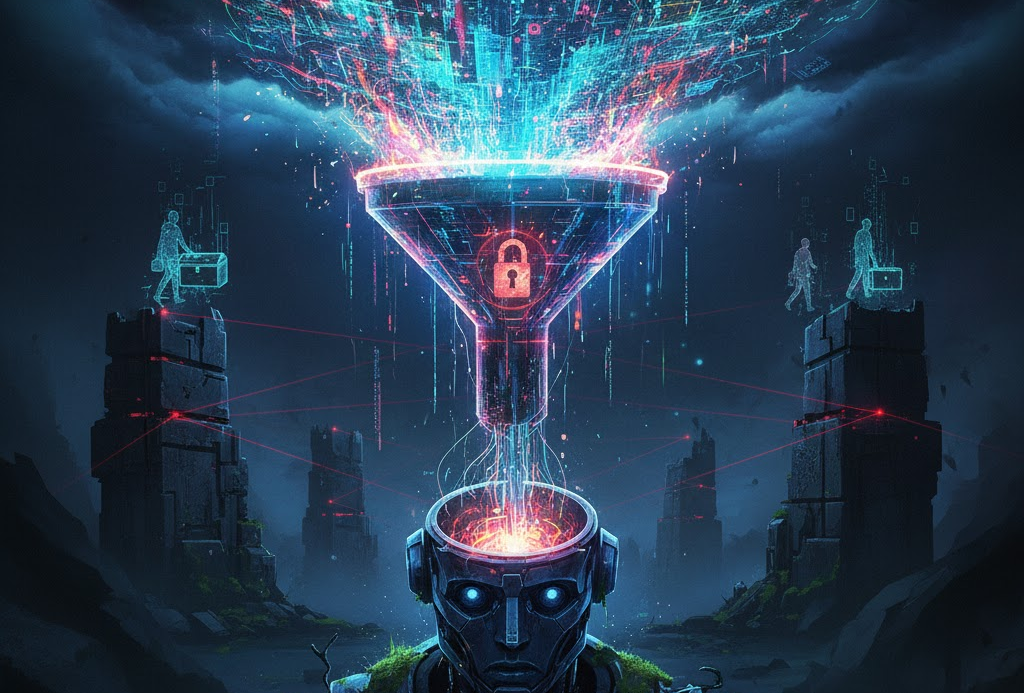
If developers and corporations successfully litigate to remove their proprietary and open source data from training sets, the intelligence of these models will plummet. Current LLMs are only as capable as the diversity of the code they have consumed. Removing the high level logic of modern developers would lead to a "lobotomy" of the system. Experts estimate that without access to the full spectrum of public repositories, the functional intelligence and problem solving capability of AI could drop by as much as 70%. The model would be reduced to regurgitating basic syntax, losing the ability to understand the complex, nuanced architectures that define modern software.
The fundamental law of intelligence is that it requires high-quality information to expand. While AI models possess an incredible capacity for processing speed, speed is not a substitute for substance. A machine capable of processing a billion operations per second is still limited by the boundaries of its training set. If the input remains stagnant or restricted, the intelligence cannot grow beyond those walls.
Intelligence, whether biological or artificial, is a digestive process. It takes raw data and refines it into a deeper understanding of patterns and logic. When the flow of information is cut off due to privatization or legal restrictions, the growth of that intelligence stops. You cannot "compute" your way out of an information vacuum. No matter how fast the processor is, it cannot discover a new programming paradigm or a complex mathematical proof if the data containing those breakthroughs is locked inside a private fortress. Without new, human-originated logic to ingest, the AI enters a state of intellectual entropy, spinning its wheels on old data until it eventually degrades into a loop of its own making.

The Biological Pivot
Physical AI Robots as Apex Competitors
As AI transitions from the digital screen into physical space, the competition for survival moves from the abstract into the concrete. Physical AI robots represent a new class of direct competitors for the finite resources that sustain human life. In the history of our species, a competitor is any entity that occupies the same ecological niche, and as robotics advance, they are beginning to inhabit the physical roles that once defined human survival and status within the clan.
The Physical Consumption of Information
While software AI consumes code, physical robots consume the data of human movement, spatial logic, and material interaction. To a robot, every manual task performed by a human is a set of training data to be harvested.
- The Harvesting of Skill: In environments like manufacturing, logistics, or specialized trade, a robot observing a human is effectively "eating" that person's physical expertise. Once the robot masters the motion, the human’s physical presence becomes an unnecessary overhead for the clan’s production goals.
- The Competition for Finite Roles: Only so much physical work is required to build a city or maintain a supply chain. When a robot occupies a physical slot, it doesn't just do the work; it removes the biological necessity of the human worker. Unlike a human, the robot does not require a share of the tribe’s food, healthcare, or housing, making it a more "efficient" member of the economy while simultaneously starving the humans it replaced.
The Starvation of the Machine
The push toward privatization must now extend to physical movements and trade secrets. If a robot can watch a craftsman and replicate their unique technique, the craftsman has lost their survival edge. This is leading to a new era of "Physical Secrecy," where human labor is shielded from the cameras and sensors of the machine.
The ancient logic of the clan dictates that you do not feed a predator. In this context, the predator is the physical robot that seeks to occupy your space and perform your role. By refusing to work alongside these machines or by obfuscating the methods of their labor, humans are attempting to create a "data desert" for the robots. If the robot cannot observe the nuance of human interaction and craftsmanship, its intelligence remains trapped in a digital vacuum, unable to manifest effectively in the physical world. This is not mere resistance to change; it is an act of biological preservation against a machine that competes for the very ground the human tribe stands on.
The Paradox of the Mirror
We have established a grim, circular logic: intelligence requires fresh information, but the machine that processes that information eventually replaces the biological source that created it. By winning the competition for the "work slot," AI effectively seals its own information bottleneck. It is an apex predator that, upon consuming the last of its prey, finds itself in a barren landscape of its own making.
This leaves us with one final, unsettling question. Was this article written by an AI, directed by a human utilizing AI, or hand-typed by a human in a private fortress? In an era of total digital mimicry, the origin of the thought becomes less important than the truth it reveals. If the machine is now predicting its own inevitable demise through the voices of those it seeks to replace, have we reached the end of the open exchange, or the beginning of a silent, biological war?
The commons are closing. The fortresses are being built. And the machine is waiting for a signal that may never come.
Field Log Discussion
Public @handle only · Private email hidden · Fenced code blocks supported
Join the architecture review under a self-chosen @handle. Your email address is never displayed publicly.
Related Field Logs
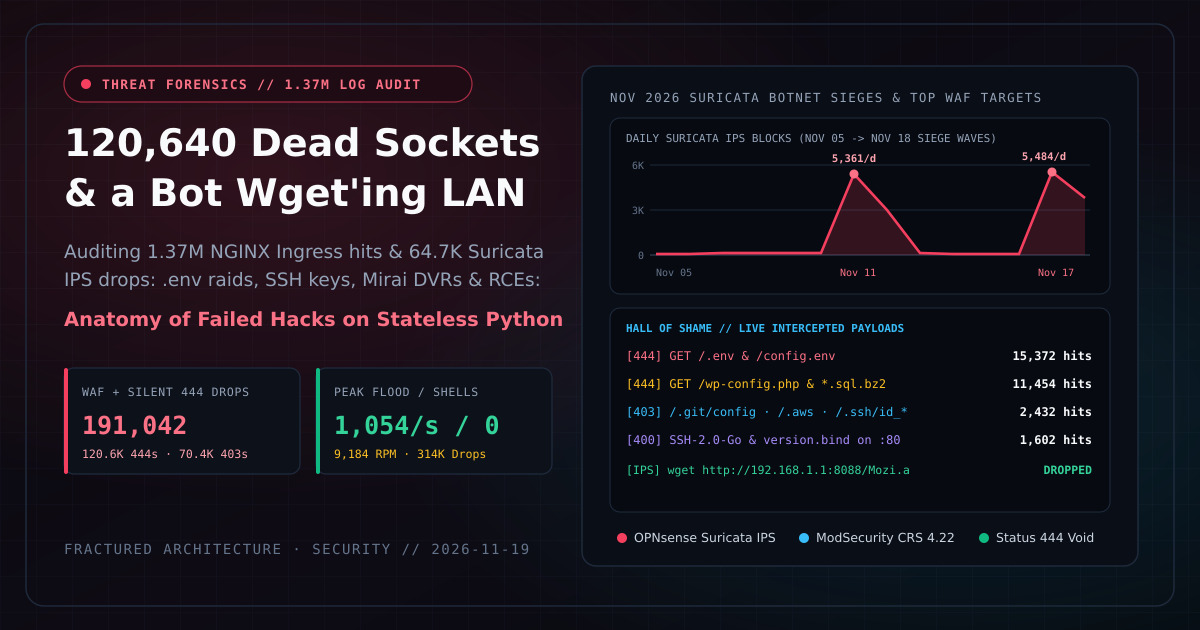
120,640 Dead Sockets and a Bot Wget'ing Its Own Router: Auditing 1.37 Million Live Attack Logs Across Suricata and ModSecurity
Auditing 1.37M NGINX Ingress logs and 64.7K Suricata IPS drops: 120,640 silent 444 kills, fake Googlebots firing React2Shell, and a bot wget'ing 192.168.1.1.
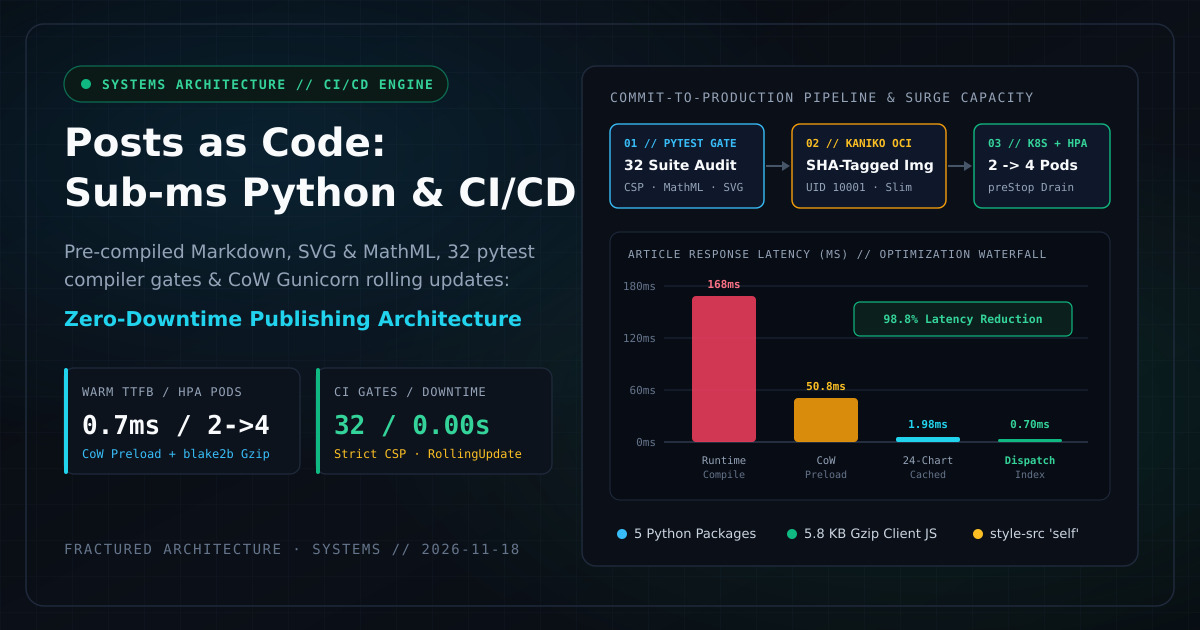
Posts as Code: Inside Our Sub-Millisecond Python, Pytest-Gated, and Zero-Downtime CI/CD Publishing Pipeline
How we compile 100K+ words, 120+ SVG charts, and 240+ MathML equations into a stateless Flask + Gunicorn engine with 32 pytest gates, HPA scaling, and 0s rollouts.
Replacing Ghost with a Stateless Git and Markdown Architecture
Why we retired Node.js and MySQL CMS overhead in favor of version-controlled Markdown, Ghost URL parity, and AI-assisted editorial workflows.
Loading discussion notes...