
Zero-Latency Architectures: Debugging Silent Drops in High-Throughput BTC ASIC Hashing
Debugging silent packet drops, Stratum latency spikes, and OPNsense state-table bottlenecks in high-throughput Bitcoin ASIC hashing networks.

The "Why": Hashing for the Sake of Hashing
Before diving into the network stack, it is worth addressing the elephant in the server room: the economics. In a world of industrial scale mining farms and venture backed operations, my setup is a different breed. I am doing this entirely for fun.
This is an exercise in extreme engineering and high performance computing (HPC). There is a specific kind of satisfaction in orchestrating a 620 TH/s array, tuning a custom OPNsense gateway, and watching a local Bitcoin full node sync in real time. While the 3.125 BTC reward is the ultimate "Golden Ticket," the real prize is the architectural challenge. For me, the true "profit" is found in the telemetry, the logs, and the pursuit of a perfectly optimized, zero-latency flow.
The Probability Engine: How Solo Mining Works
At its core, Bitcoin mining is not about "calculating" in the traditional sense. It is a massive, decentralized competition to find a specific number through brute force. This process, known as Proof of Work, requires running a SHA-256 hashing algorithm trillions of times per second. The goal is to produce a hash lower than a specific target set by the network difficulty.
Think of it as a global digital lottery where every hash is a ticket. Most participants join "pools" to smooth out their income by sharing the rewards. However, a strict solo miner plays a different game. You aren't looking for a steady paycheck; you are hunting the block itself.
At a scale of 620 TH/s, I am throwing 620 trillion tickets into the hat every single second. But in this winner-take-all race, speed is everything. If you find the solution but your network is slow to deliver it to the blockchain, another miner might beat you to the broadcast. This results in an** Orphaned Block or a Stale Share**. You held the winning ticket, but you arrived at the booth after it closed. This is why the network architecture behind the hashing power is just as critical as the hardware itself.
The Infrastructure: Full Node, bitcoin, ckpool, and ckstats
To maximize the "Solo Edge," we don't rely on external pool providers. Instead, we run a private, localized mining stack. This starts with a Bitcoin Core Full Node. By maintaining our own copy of the blockchain, we eliminate the latency of waiting for a third-party server to tell us when a new block is found.
Sitting on top of the node is ckpool. This is a specialist, ultra-low-overhead mining pool engine designed for performance. Unlike commercial pools with heavy web interfaces and complex database backends, ckpool is a lean C-based service that talks directly to the local Bitcoin daemon. It manages the worker connections and validates every share submitted by the hardware.
To visualize the health of the 620 TH/s stream, we use ckstats. This provides a real-time dashboard of hashrate averages, share difficulty, and worker uptime. It is here that we monitor the** Best Share found by each worker. For instance, hitting a 231B** difficulty share is a significant milestone, even if it doesn't meet the current network target of roughly 100T. It proves the hardware is finding "high-value" tickets.
Visualizing the Stream: InfluxDB and Grafana
While ckstats provides the "now," true architectural oversight requires historical context. To achieve this, we pipe our share logs into an InfluxDB time-series database.
By parsing the raw output of our worker logs, we extract every accepted share and its associated difficulty, then plot that data in Grafana. This gives us a high-fidelity view of our hashing efficiency:
- Difficulty Distribution: We can see if our hardware is consistently hitting the expected difficulty spread.
- Work Verification: Grafana dashboards allow us to ensure that both units in the 620 TH/s array are contributing equally over time.
- Trend Analysis: By comparing current share difficulty against network difficulty, we can visually track how close we are getting to that elusive block solution.
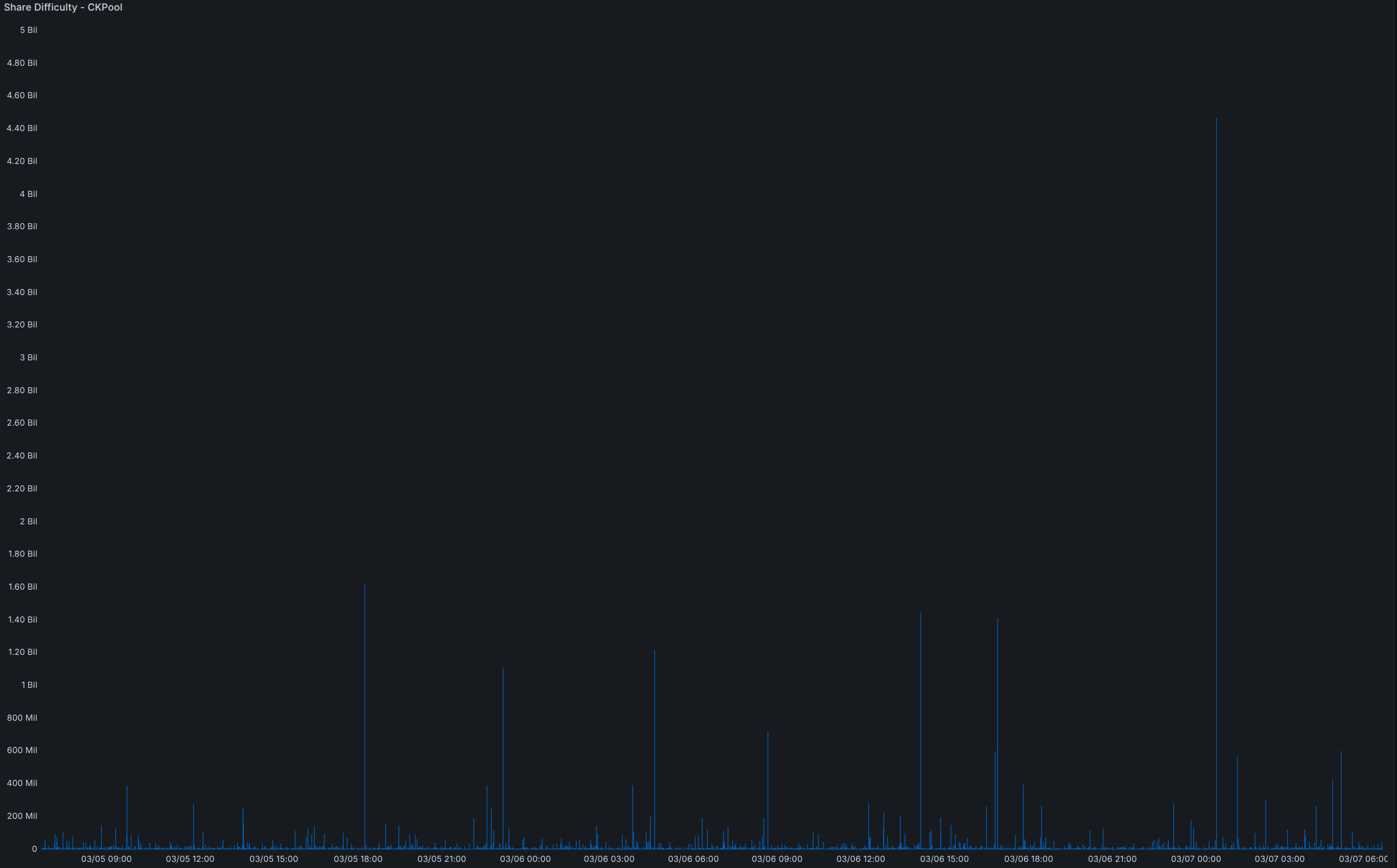
Example real-time share difficulty of a 200TH/s miner
The Setup: A 620 TH/s Environment
Operating at a scale of 620 TH/s requires more than just raw power. It requires a network architecture that can handle sustained, high frequency JSON-RPC traffic without jitter. When you are strict solo mining, the network is your only bridge to the lottery. In this environment, even a minor misconfiguration in your packet inspection engine can turn an elite hashing array into a collection of Zombies. These are units that appear online but are effectively shouting into a void.
The 3:00 AM Incident: When Monitoring Works
The real value of this architecture was proven not during a routine check, but through a critical alert. While away from the terminal, a Pushover.net notification hit my iPhone, triggered by a custom Python monitor watching the ckpool share logs.
The alert was specific: a "Low Throughput" warning for a single worker in the 620 TH/s array. While the overall pool hashrate looked healthy to a casual observer, the granular telemetry showed that one unit had effectively flatlined. This wasn't a hardware crash or a power failure; it was something far more subtle.
The Invisible Wall: Advanced Inspection vs. Real-Time Payloads
In a hardened network, we often deploy advanced Intrusion Prevention Systems (IPS) to monitor for anomalies. However, these engines are designed to look for patterns. The rhythmic, repetitive nature of Stratum V1 mining traffic can occasionally trigger Protocol Mismatch flags in the inspection engine.
The most dangerous failure isn't a hard disconnect. It is a Silent Drop.
- The Symptom: The TCP connection remains established and low level heartbeats (Keepalives) continue to flow every 30 seconds.
- The Reality: The IPS engine has desynced the application layer. It allows the TCP ACK packets through but silently discards the actual JSON-RPC
mining.submitpayloads. - The Result: A** 0.00447% rejection rate** suddenly spikes to 100% loss for that specific worker. Standard "Offline" alerts which usually rely on socket status never fire because the connection is still technically open.
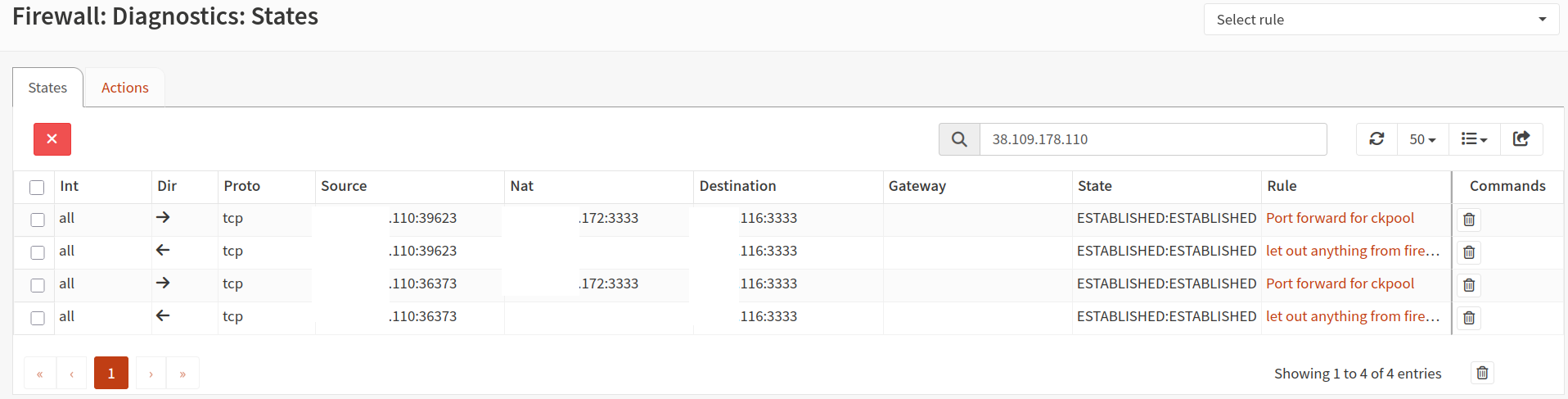
OPNsense firewall diagnostic state - sensitive data filtered
The Solution: Surgical Bypass and Flow Offloading
To solve this, we move away from global inspection and toward Surgical Bypassing. By utilizing advanced firewall rules, we can identify trusted high throughput flows and move them into a** Bypass** state.
Step 1: The Hybrid Diagnostic
To catch a Zombie in the act, you need a monitoring stack that looks at both the transport and application layers simultaneously. Using a combination of tcpdump and jq, we can create a real time audit log that interleaves raw TCP flags with prettified JSON:
Bash
# Monitoring the 620 TH/s stream for silent drops
tcpdump -ni [Interface] -l -A -s 0 host [Remote_Endpoint] | while read -r line; do
    if echo "$line" | grep -q '^{.*}$'; then
        echo "$line" | jq --unbuffered .
    else
        echo "$line"
    fi
done
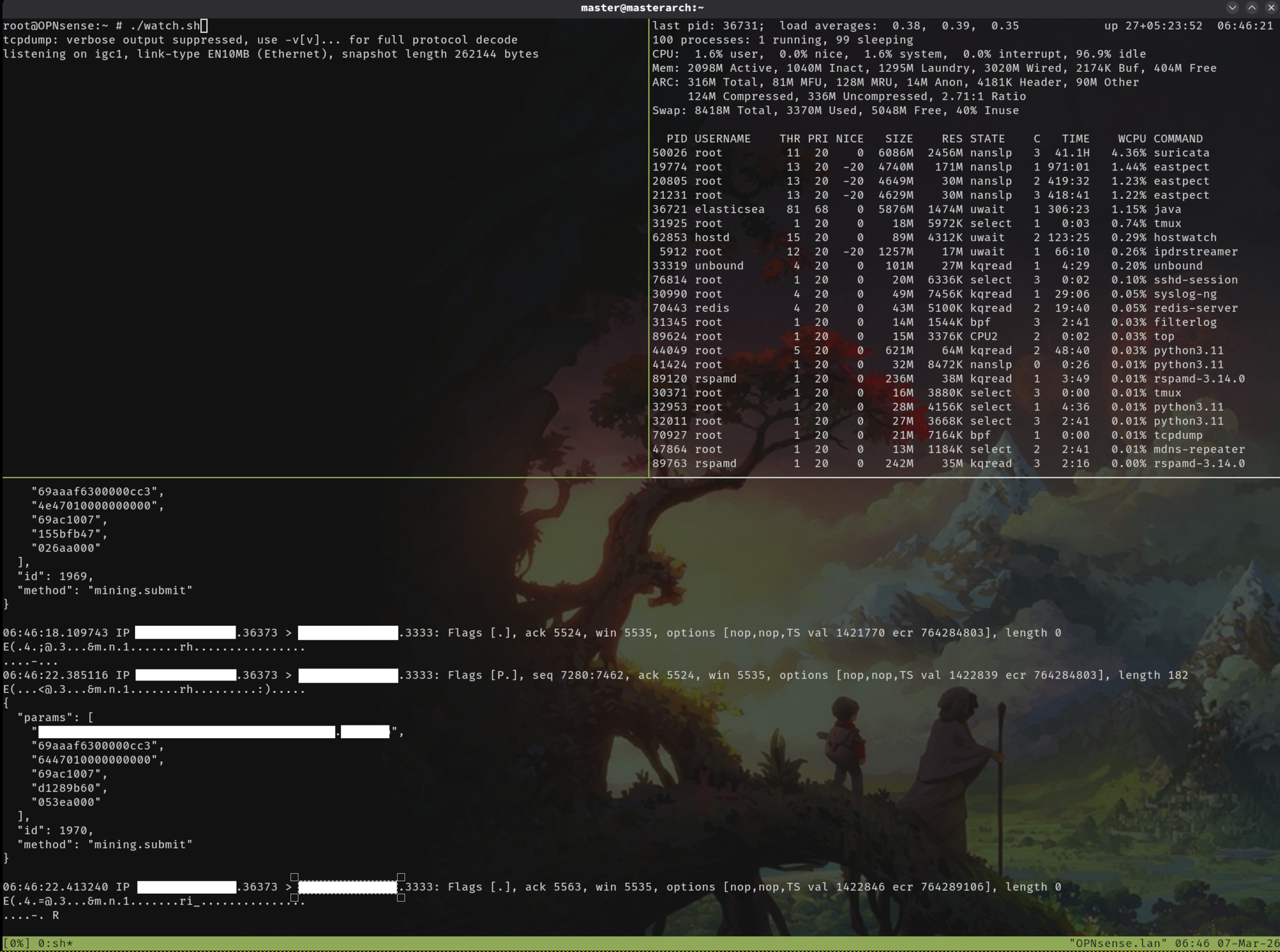
Example tcpdump trace confirming networking and stability/performance
Step 2: Implementing the Bypass Rule (The Isolation Verdict)
Once a potential Silent Drop is identified, we implement a Pass + Bypass logic in the firewall. This tells the stream engine to trust this specific conversation between these IPs and route the packets without inspection.
- Variable Elimination: By removing the inspection overhead, we surgically isolate the network from the hardware.
- Performance Gain: This keeps the system at a** 95%+ idle state and reduces the Time to Pool** for every share submitted.
- Stability Gain: It prevents the IPS from ever seeing a Protocol Mismatch, ensuring the network path remains theoretically perfect for weeks.
In this architecture, the bypass rule serves as the ultimate diagnostic tool. If the issue persists after clearing the path, we have moved the investigation from a "stack problem" to a definitive hardware verification.
The Race Condition: Why Every Millisecond is a Bitcoin
In solo mining, the bypass rule is your most critical latency optimization. When your hardware finds a hash that meets the network difficulty, you are in a literal race against every other miner on Earth to broadcast that solution to the network.
If your firewall spends even a few extra milliseconds performing deep packet inspection on that specific mining.submit packet, you risk a race condition. If a miner in another part of the world finds the same block a fraction of a second after you, but their network path is more optimized, their block reaches the nodes first. Your winning ticket is then rejected as a** stale share** because the network has already moved on to the next block height. By bypassing the inspection engine, you ensure your solution hits the wire the absolute instant your hardware generates it.
Engineering for the Inevitable: Observability as Insurance
In any high-performance compute environment, the primary goal of infrastructure is to eliminate ambiguity. While the initial intent was to resolve a network drop, the true value of this architecture is that it ensures future disruptions never occur in a vacuum. By integrating InfluxDB for persistent telemetry, Grafana for trend visualization, and Pushover for real-time alerting, we have built a proactive defense against downtime.
We no longer have to wonder if the system is performing at its peak; the data tells the story in real time. If the 620 TH/s stream deviates from its expected baseline, the system triggers an immediate notification. This independent, external audit trail provides the granular data required for surgical troubleshooting. We have effectively transformed a potential "Silent Drop" catastrophe into a manageable event where we are alerted the moment work stops being done.
The Conclusion: Precision over Power
At 620 TH/s, you are no longer just a hobbyist. You are managing a high-performance compute cluster. The lesson here is that as your security stack becomes more intelligent, it also becomes more prone to over-policing the very traffic you rely on.
By implementing surgical bypasses and advanced real-time logging, we reclaim the lottery edge that solo mining requires. We move from a state of hoping the network is stable to knowing our path is clear for the one share that actually matters. Even if the hardware itself falters, this architecture ensures we find the truth quickly.
Field Log Discussion
Public @handle only · Private email hidden · Fenced code blocks supported
Join the architecture review under a self-chosen @handle. Your email address is never displayed publicly.
Related Field Logs
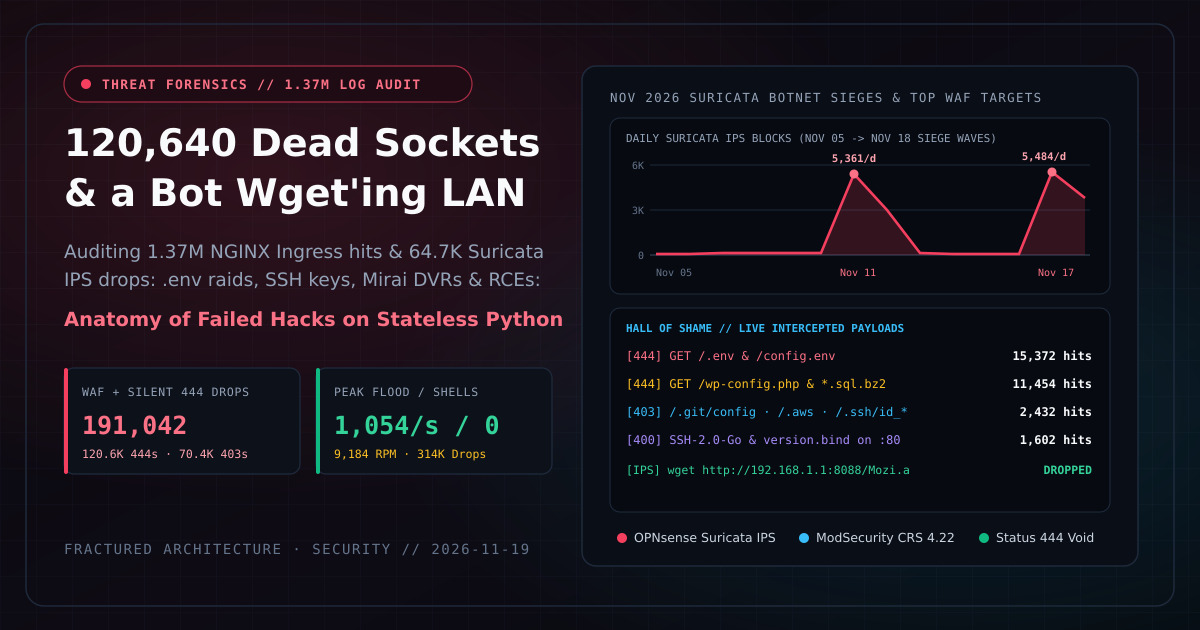
120,640 Dead Sockets and a Bot Wget'ing Its Own Router: Auditing 1.37 Million Live Attack Logs Across Suricata and ModSecurity
Auditing 1.37M NGINX Ingress logs and 64.7K Suricata IPS drops: 120,640 silent 444 kills, fake Googlebots firing React2Shell, and a bot wget'ing 192.168.1.1.
Mail Sovereignty Part II: Building a Professional, Self-Hosted Stack
Master self-hosted email sovereignty. Build a hardened OPNsense, Postfix, Rspamd, and Redis mail gateway with Route53 DNS-01 TLS and firmware-safe recovery.

Architecture: The 10G eBPF Edge with OPNsense & Istio-Ready Cilium DSR
Achieve maximum 10G throughput. Learn how to configure Cilium with Native Routing and DSR for real client IP preservation and enterprise-grade observability.
Loading discussion notes...