
Equity Market Valuation Comedy
Why classical Discounted Cash Flow models collide with algorithmic momentum, passive liquidity flows, and AI multiple expansion in modern equity markets.

The traditional Discounted Cash Flow model is no longer a financial instrument. In the current market regime of May 2026, it is a comedic prop.
We are operating in an environment where algorithmic trading engines and quantitative developers are forced to look at textbooks written by Graham and Dodd, acknowledge the math, and then throw the book out the window. The disconnect between intrinsic gravity and market escape velocity has reached a point of pure, unadulterated hilarity.
The Punchline: Pure DCF vs. SaaS Hyperscalers
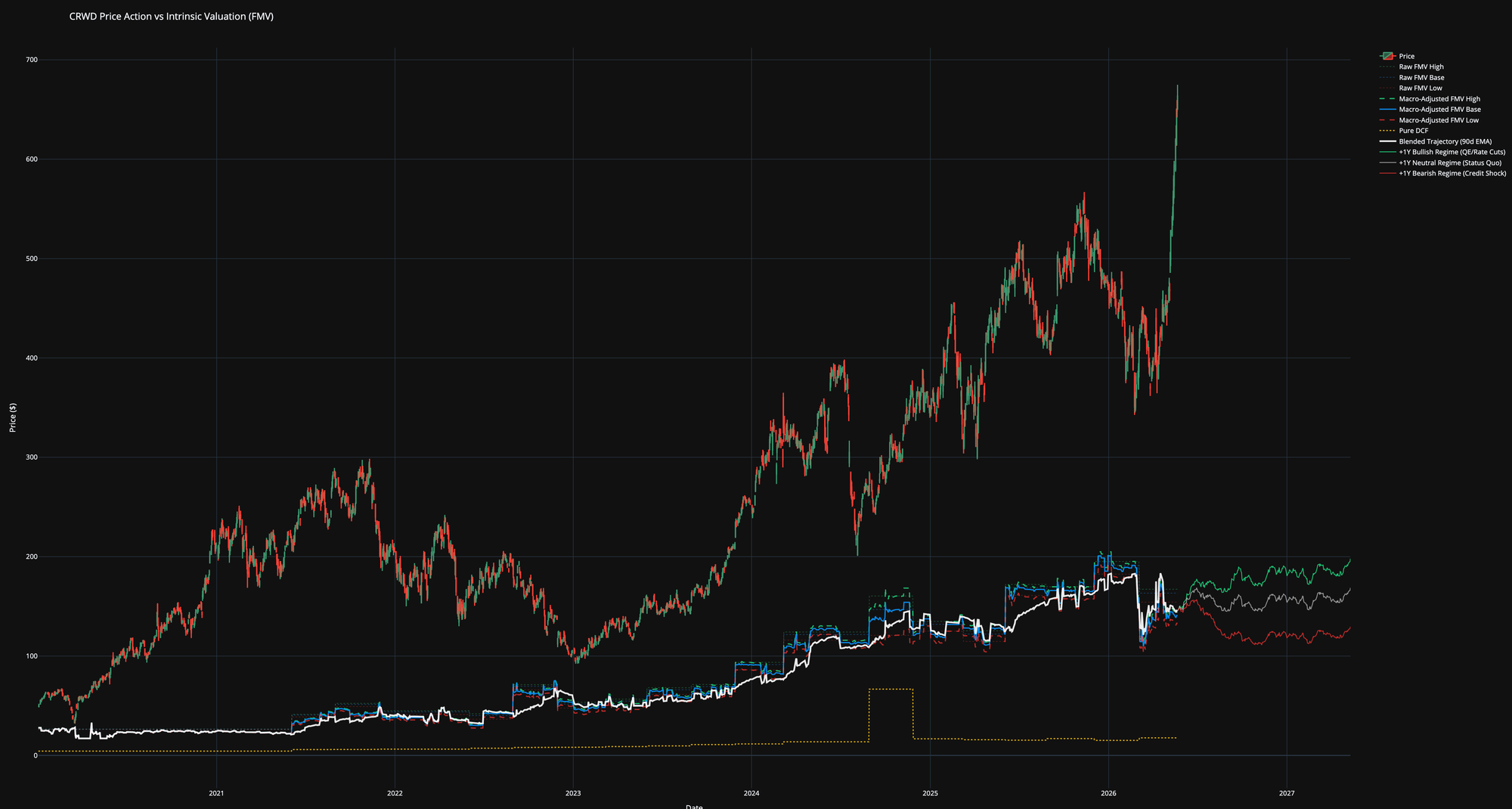
The joke becomes obvious when you apply strict fundamental baselines to modern SaaS and AI hyperscalers. Take cybersecurity infrastructure as the ultimate punchline. If you calculate the pure discounted cash flow of an asset like CrowdStrike based on strict, present-day free cash flow, the mathematical reality outputs a fundamental floor somewhere around $15 a share.
CRWD
The market reality? The asset trades well north of $400.
This is a 2,700% premium to its pure DCF. Wall Street is not pricing in present execution. They are pricing in an alternate universe where every enterprise on earth doubles its cybersecurity budget every two years to perpetuity. Traditional valuation models are fundamentally hostile to this type of hyper-growth architecture because they cannot quantify an AI premium until it actually hits the balance sheet.
The Hardware Hallucination: Seagate Technology (STX)
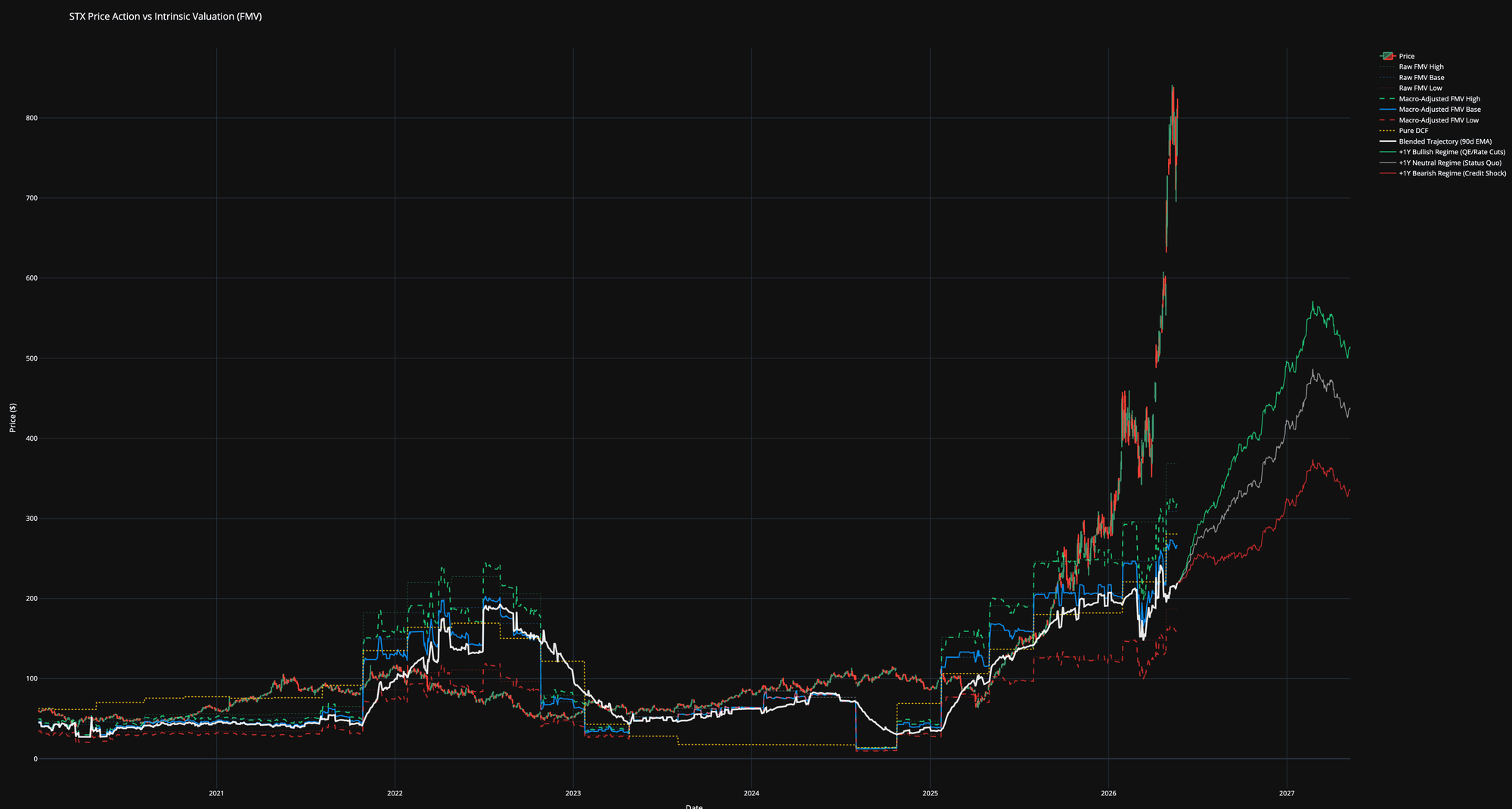
The valuation comedy isn't restricted to software; it routinely infects legacy hardware. Look at Seagate Technology (STX). At its core, storage is a capex-heavy, historically cyclical commodity business. Yet, intoxicated by the "AI data center footprint" narrative, the market occasionally decides to price spinning hard drives like high-margin software monopolies.
If you run the math, a pure DCF reveals a rigid, low-growth fundamental floor. The stock price, however, has a habit of going parabolic, entirely detaching from its cash flow reality to ride the macroeconomic narrative. If an automated engine doesn't recognize this as a momentum anomaly and relies strictly on that fundamental ceiling to fade the move, it gets completely run over. STX serves as a prime candidate for an OVERVALUATION_SHORT multiplier, a setup that requires absolute discipline, waiting patiently on the sidelines for the kinetic momentum to finally fracture before stepping in to ride the void downward.
STX
The Turnaround Hallucination: Intel (INTC)
If you want to see what happens when a legacy giant attempts to pivot at the cost of its balance sheet, look at Intel. This is not a value trap; it is a turnaround hallucination.
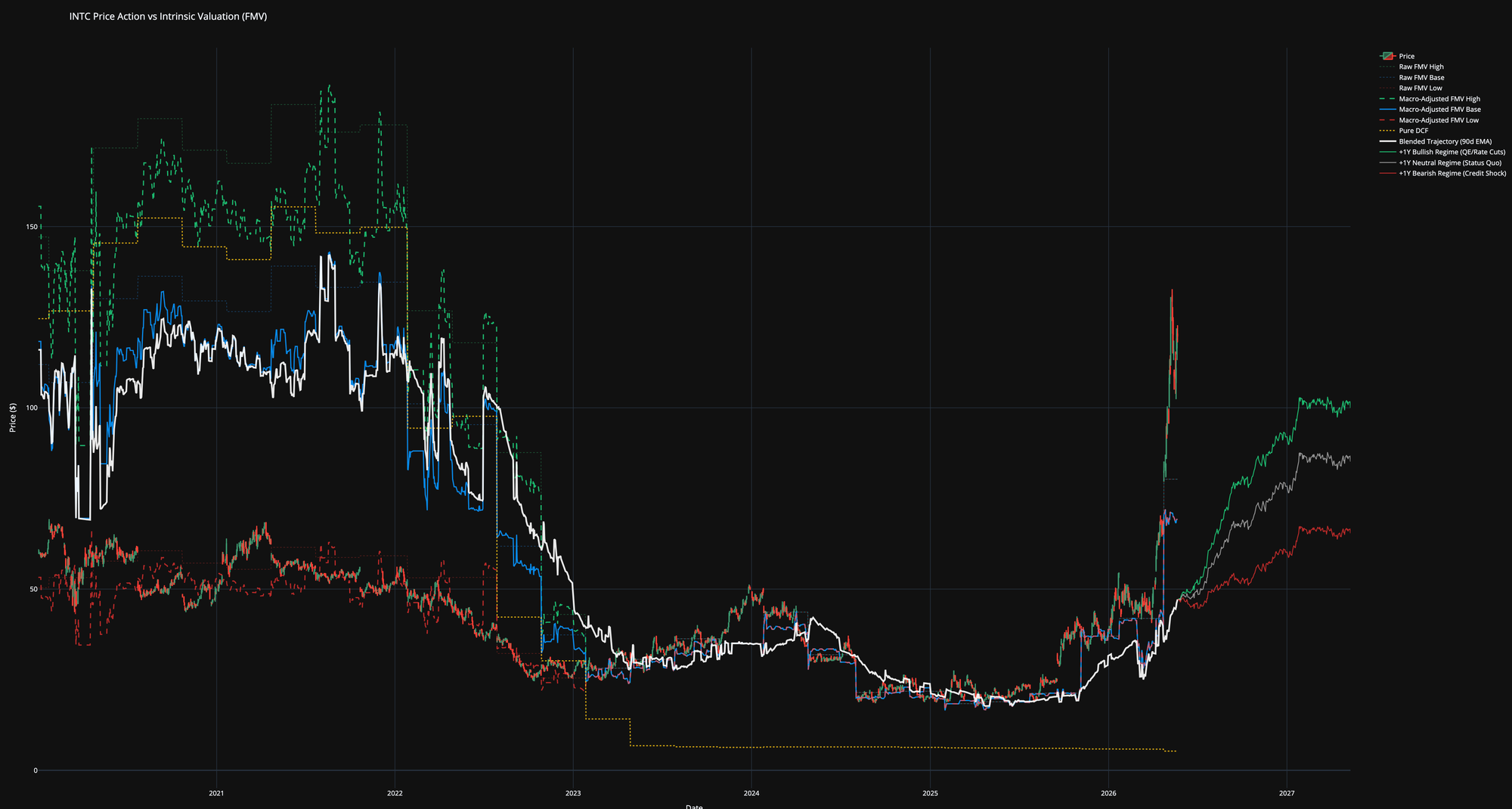
When you run a traditional Discounted Cash Flow model on INTC starting in late 2022, the algorithmic output is brutal. The pure DCF line drops off a cliff and flatlines at literal pennies. Why? Because Intel's massive capital expenditures to build out its new foundry business completely obliterated its free cash flow. A rigid quantitative model looks at the present cash generation and concludes the company is effectively a zombie.
But look at the price action in late 2025 and early 2026. The stock violently goes supernova, spiking vertically and completely detaching from its fundamental baselines. Wall Street is not pricing in current cash realities. They are pricing in a government subsidized, decade long manufacturing renaissance, willingly ignoring the massive ongoing cash burn required to get there.
For an automated system, this chart is a minefield. If the engine looks solely at the pure DCF, it refuses to touch the asset. But if it attempts to short the vertical spike simply because the cash flow is dead, it gets obliterated by the narrative squeeze. Intel proves that when the market decides to price in a miraculous resurrection, intrinsic valuation becomes completely irrelevant until the exact moment the institutional conviction finally exhausts itself.
INTC
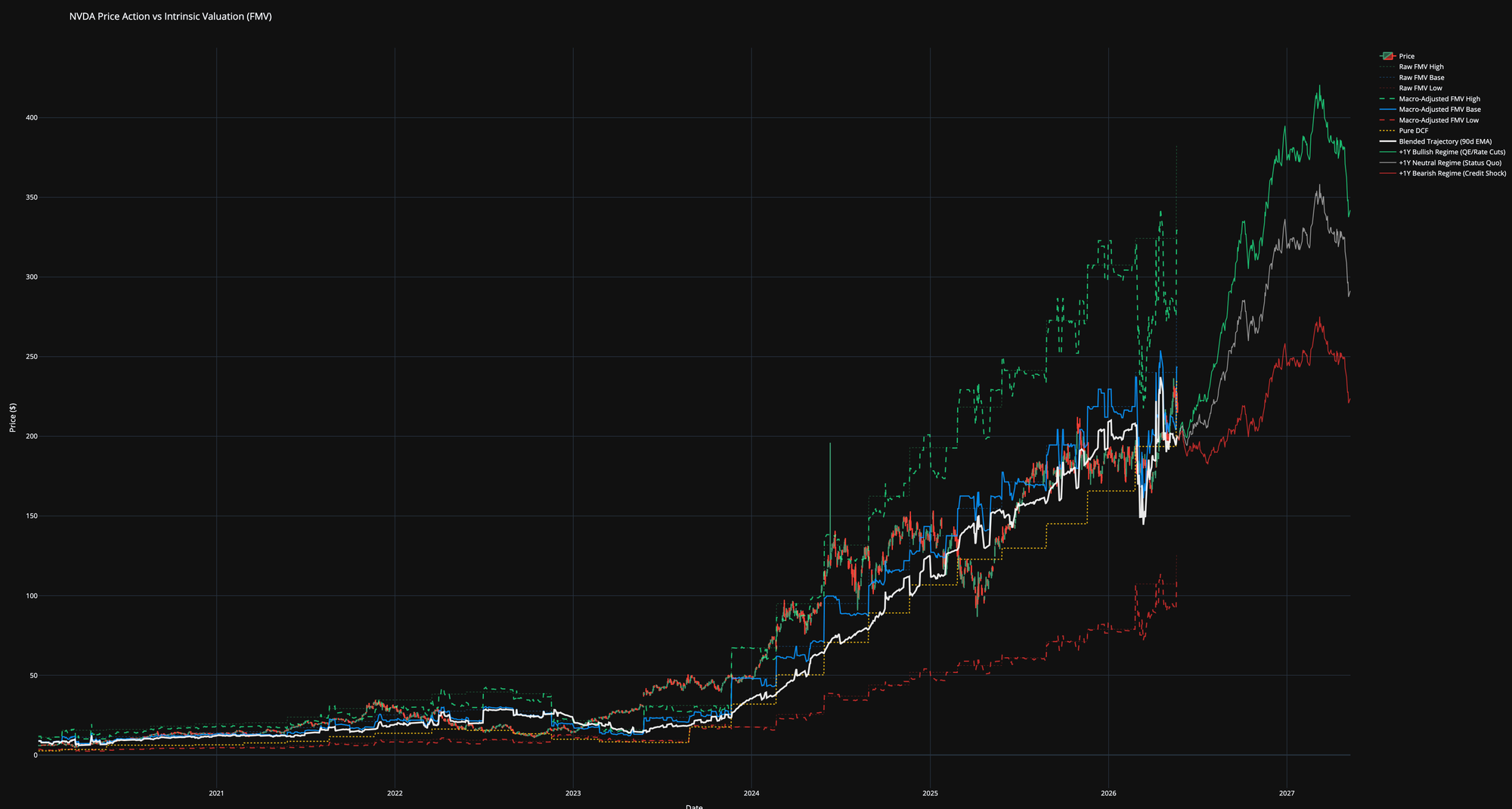
Here is one that has some sanity believe it or not.
NVDA
The Infrastructure Mirage: CoreWeave (CRWV)
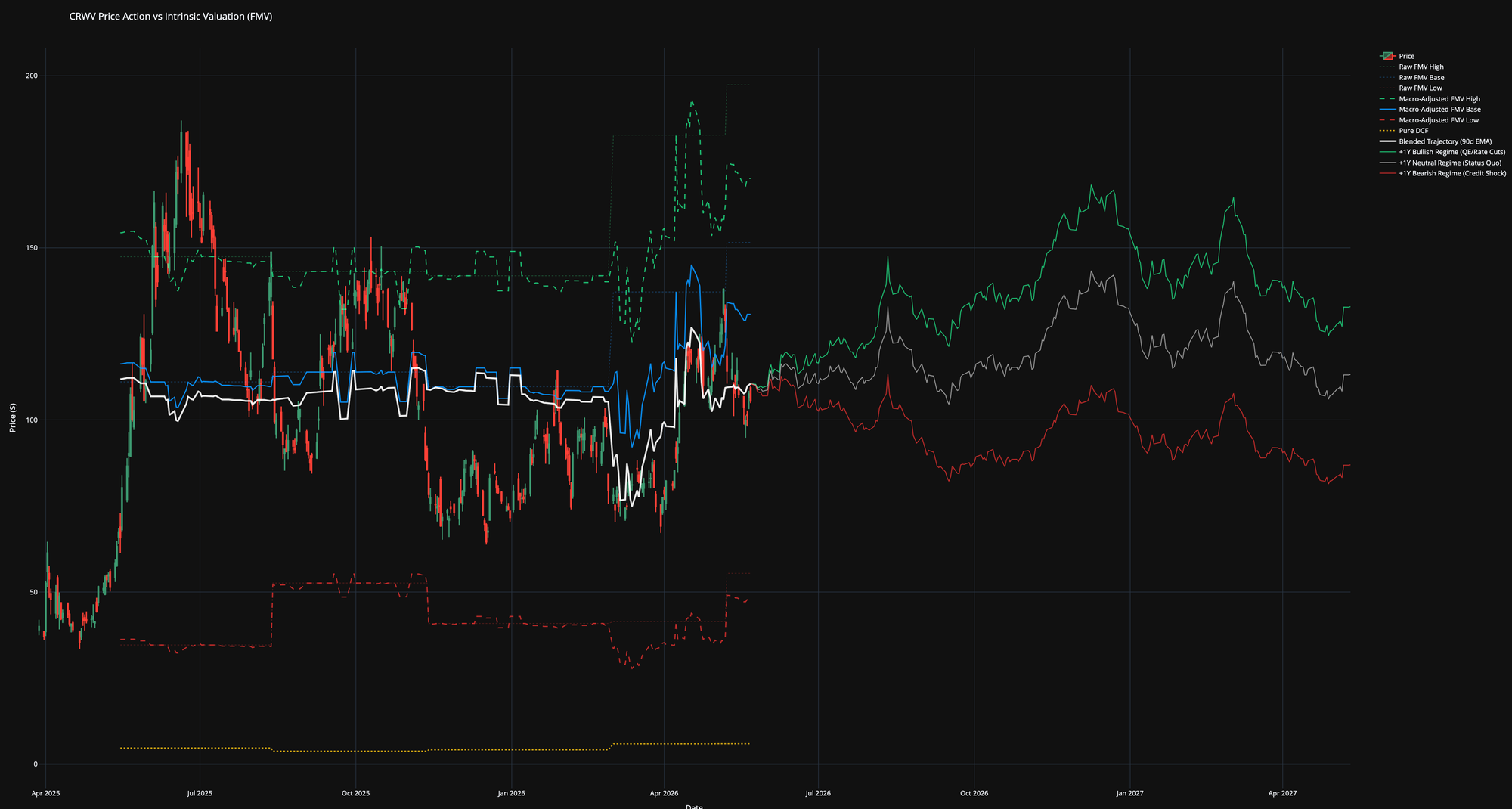
If software multiples provide the setup for valuation comedy, physical AI infrastructure delivers the ultimate punchline. CoreWeave (CRWV) is the perfect anatomy of a hyperscaler hallucination.
When you run a strict Discounted Cash Flow analysis on a capex-heavy GPU cloud provider, the fundamental floor does not just drop. It flatlines. The pure DCF line for CRWV hovers near absolute zero. The company is funding massive compute expansion through billions in syndicated debt facilities, currently operating with a deeply negative EPS of $3.26. Traditional present-day cash flow math values the asset at pennies.
The market, however, fed this equity into the exact same hyperscaler AI models that vastly overestimate growth, projecting infinite demand to perpetuity. Seduced by the neocloud narrative, the price action completely detached from fundamental gravity, sending the stock to a parabolic peak of $187.00. The blended intrinsic trajectory attempted to chase the price upward, but the pure DCF remained anchored to the zero-bound reality.
Then the momentum died. As of late May 2026, the stock has cratered back to the $105.00 level. The narrative fractured under the weight of a massive debt load, wider earnings misses, and the reality of a newly announced $5 billion Google and Blackstone joint venture entering the space. Wall Street analysts who were previously caught in the euphoria are now frantically slashing price targets back down to $100.00.
For a quantitative execution engine, CRWV proves a vital mechanic. When the pure DCF is near zero and the price is orbiting in the stratosphere, you are not trading an equity. You are trading a temporary psychological narrative. If an algorithm relies on a hyperscaler model that overestimates terminal growth to justify the premium, it becomes the exit liquidity when the kinetic momentum finally breaks and gravity takes over.
CRWV
The Retail AI Cult: Palantir (PLTR)
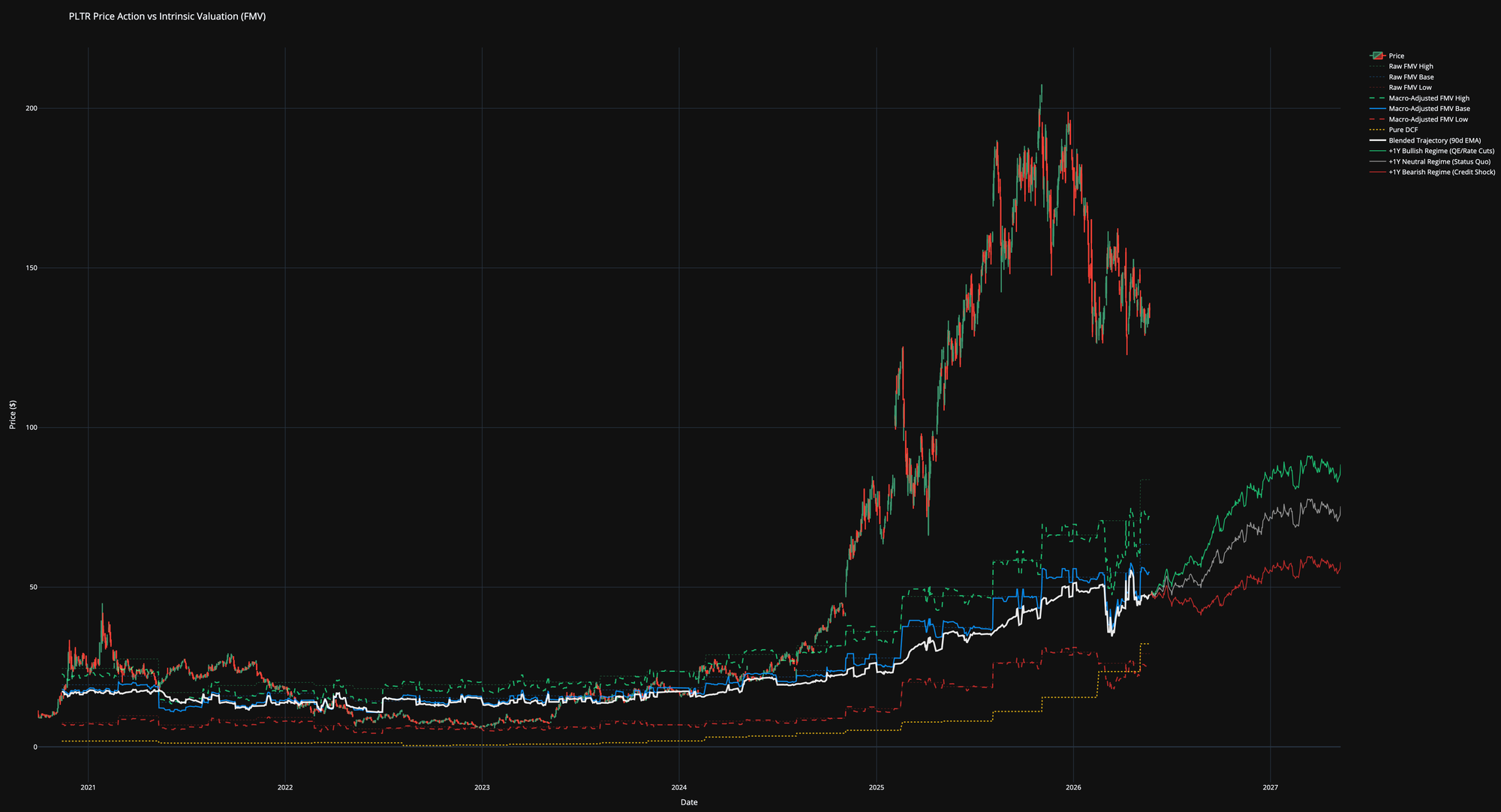
If you want to see what happens when retail euphoria collides with institutional AI hype, look no further than Palantir. This chart is a masterclass in narrative detachment.
Look closely at the left side of the data. From 2021 through early 2024, PLTR was actually a well-behaved asset. It perfectly respected fundamental gravity, tightly hugging the white blended trajectory line while the pure DCF provided a rational, albeit low, valuation floor. The math and the market were speaking the same language.
Then the Artificial Intelligence Platform narrative took hold, and the market stopped pricing in software contracts and started pricing in Palantir becoming the digital operating system for the entire Western hemisphere.
The price action violently ruptured the macro-adjusted ceilings and went completely supernova, spiking from the $20 range to a peak well over $200 in late 2025. Notice the sheer absurdity of the void: at its absolute peak, the stock was trading at $200 while the pure, cash flow-driven DCF (the yellow dotted line) barely nudged above $30.
But gravity is patient. As the calendar rolled into 2026, the momentum broke and the narrative fractured. The stock suffered a brutal post-squeeze collapse, shedding nearly half its peak value in a matter of months. Yet, the punchline remains: even after a catastrophic crash, PLTR is still floating in a liquidity void, trading wildly above the most generous forward-looking fundamental projections.
For an automated execution engine, PLTR is the ultimate lesson in mechanical discipline. Shorting the ascent destroys your portfolio. You must wait for the exact moment the kinetic momentum dies. Once the indicators roll over at the peak, the engine feasts on the downside, riding the vacuum back toward a fundamental floor that is still miles below the current price.
PLTR
PLTR - SBC
The Optical Illusion of Stock-Based Compensation
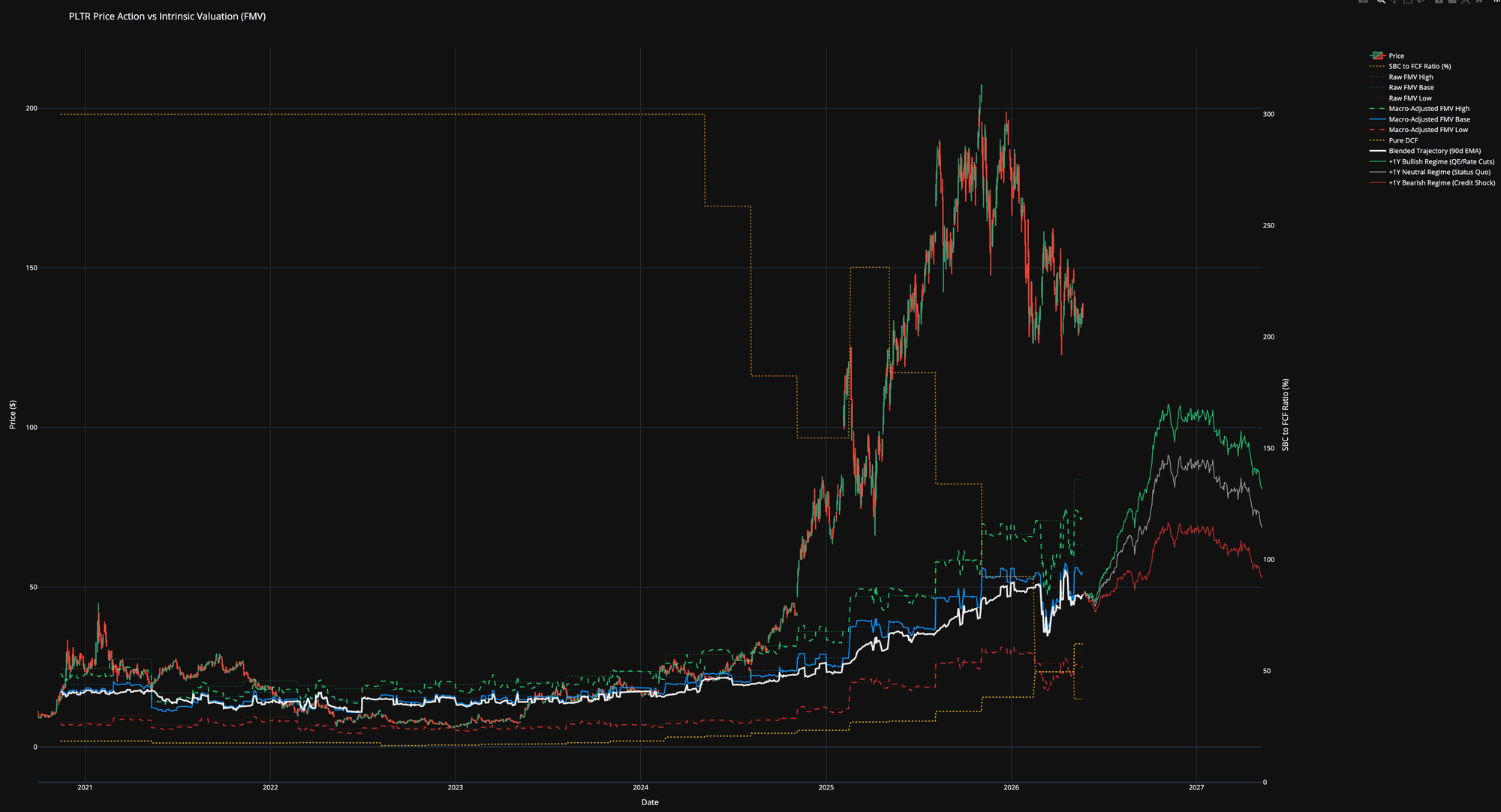
The punchline to the Palantir comedy lies hidden in the accounting. Specifically, it hides within Stock-Based Compensation (SBC). If you plot a raw $0.22 per share SBC expense against a stock price soaring past $200, it looks like microscopic background noise. This creates a massive optical illusion.
To see the true mechanical drag on the valuation, you cannot compare SBC to the market capitalization. You must compare it to the actual cash the business generates. When you map SBC as a percentage of Free Cash Flow on a secondary axis, the illusion completely vanishes.
During the height of the initial retail frenzy, Palantir was printing up to three dollars in new stock for every single dollar of actual free cash flow it generated. Even as the company matured into 2026, the ratio persistently hovered near 50 to 100 percent. This is not just an operating expense. It is a structural wealth transfer from retail shareholders to corporate insiders.
When half of your operating cash flow is continuously eaten by dilution, the underlying Discounted Cash Flow math is physically incapable of rising to meet a narrative driven stock price. For an automated execution engine, this metric is the ultimate cheat code. If a ticker is trading at a massive premium to its blended fair market value while simultaneously sporting an 80 percent SBC to FCF ratio, the system knows with absolute mathematical certainty that the price is suspended purely by retail euphoria.
The Hardware Hallucination: Tesla (TSLA)
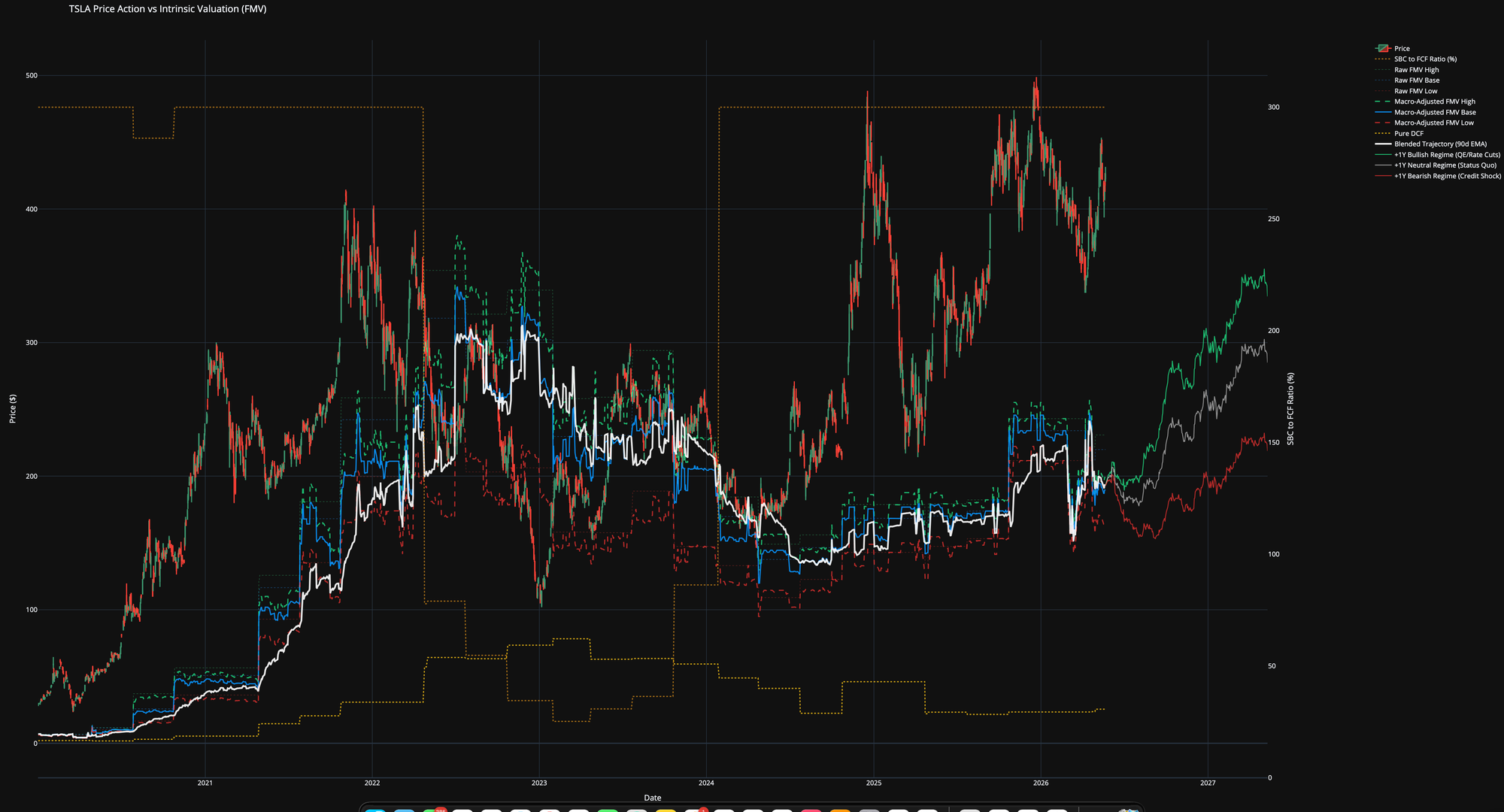
This mechanical trap is not isolated to enterprise software. If you apply the exact same Stock-Based Compensation lens to the physical world, Tesla emerges as the ultimate hardware hallucination.
TSLA
While the market prices Tesla as an infinite robotics and artificial general intelligence monopoly, the underlying cash flow tells a much darker, capital-intensive story. As of May 2026, the strict present-day free cash flow math anchors Tesla's fundamental floor near $25.50. Yet, much like Palantir, the narrative completely detached from reality, sending the price action violently through the intrinsic ceilings and into a massive liquidity void.
The connective tissue between the two assets is the accounting. If you chart Tesla's SBC to Free Cash Flow ratio on a secondary axis, you see the exact same anomaly: massive spikes violently pegging against the 300 percent ceiling. The company is heavily diluting its equity to fund its AI initiatives, effectively neutralizing what little free cash flow the core automotive division generates. For a quantitative engine, this is the identical optical illusion. The system sees the $25 fundamental reality, tracks the massive SBC dilution, and mathematically recognizes that the premium is suspended purely by narrative conviction.
Let's have a look at another shall we? How about PFE?
The Inverse Comedy: When Math Hallucinates
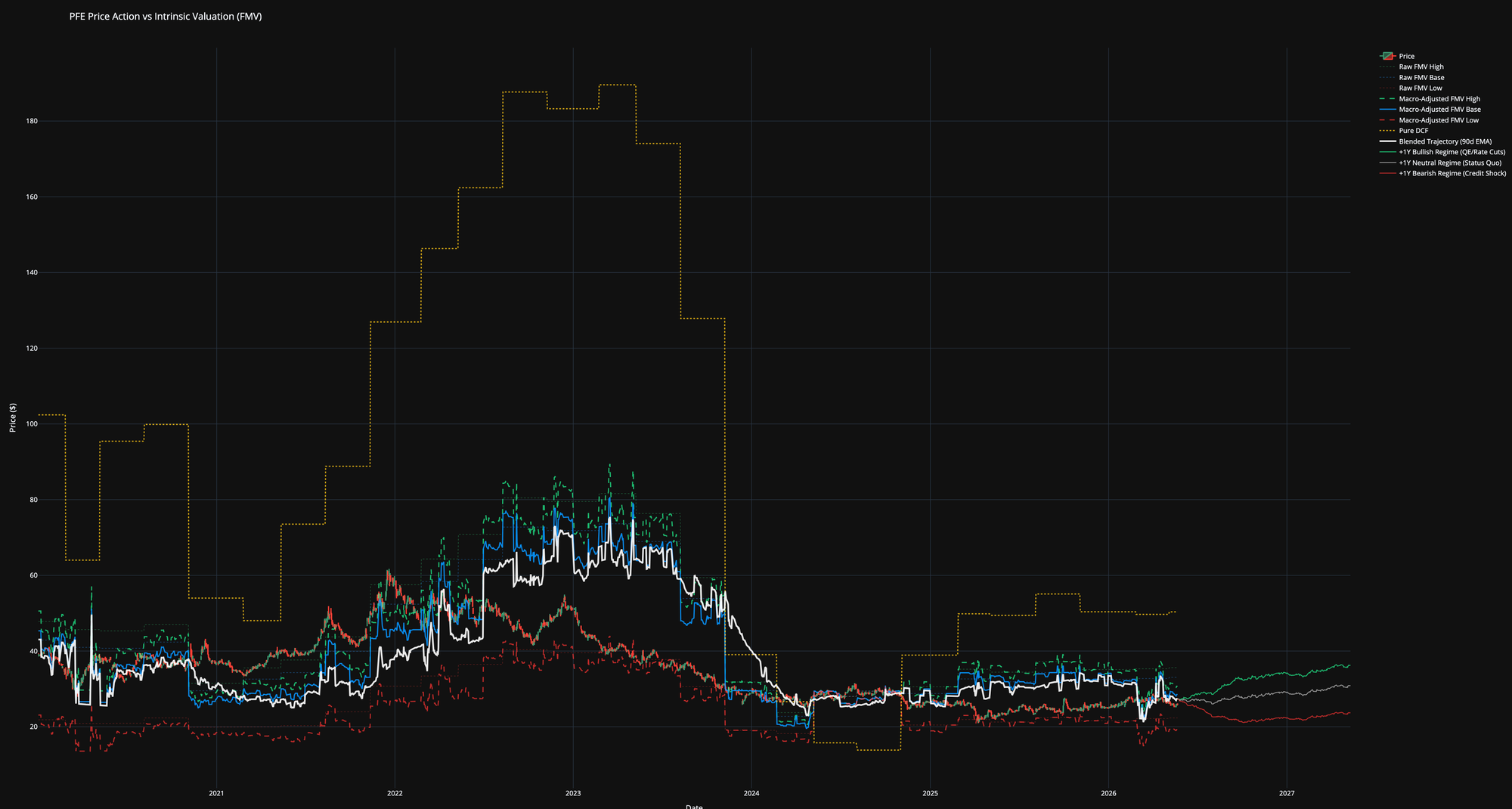
The comedy works in reverse, too. Look at a legacy pharmaceutical asset like Pfizer. While hyperscaler math breaks because the market hallucinates infinite future growth, Pfizer broke the model because the math hallucinated infinite historical cash flow.
During the 2022 and 2023 pandemic windfall, Pfizer's pure DCF calculations absolutely skyrocketed. The rigid algorithm ingested massive, one-off vaccine revenues and extrapolated them into terminal value. The math assumed the windfall would last until the end of time, outputting fair value targets near $190 a share.
Wall Street, however, knew the cash flow was a temporary macroeconomic anomaly and sold the reality. The stock peaked near $60 and initiated a brutal multi-year bleed, completely ignoring the algorithmic floor. Any quantitative system buying that "deep value" discount was catching a falling knife.
PFE
The Control Group: The Inevitable Triumph of Gravity
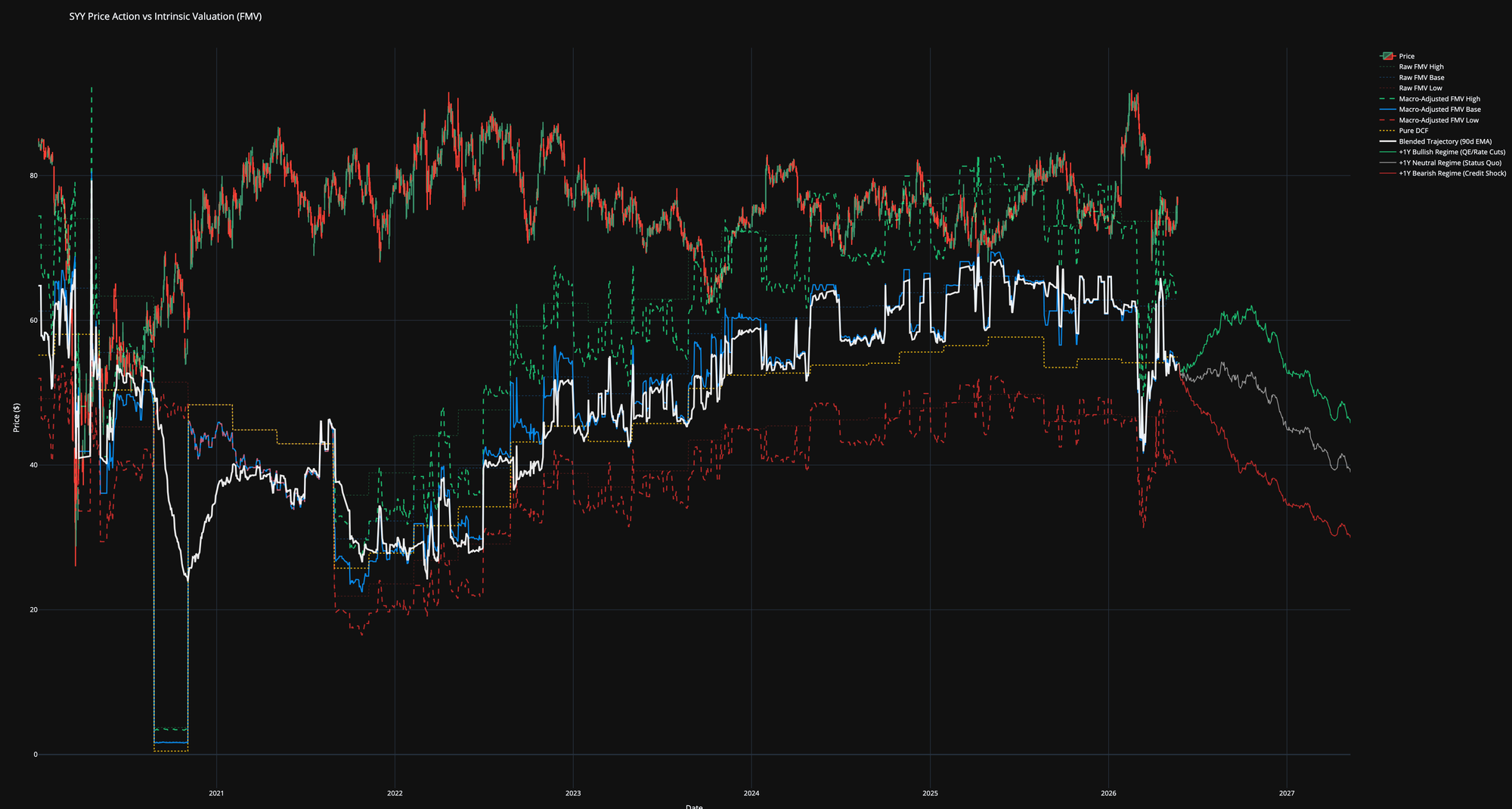
If CrowdStrike is the market hallucinating the future, and Pfizer is the math hallucinating the past, a mature, low-beta asset like Sysco (SYY) serves as the control group for fundamental reality.
For years, the price action stubbornly floated at a persistent premium to the intrinsic baseline. But unlike high-beta tech, this was not driven by exponential escape velocity or a hyperscaler narrative; it was suspended by institutional defensive rotation. The market was willing to overpay for boring, predictable food distribution cash flows.
But look at the far right edge of the data leading into mid-2026. There is no permanent escape velocity here. The moment the macro tide shifts, fundamental gravity takes absolute control. The price action is violently mean-reverting, collapsing directly back into the macro-adjusted FMV baselines and the pure DCF floor.
It proves the ultimate quantitative reality: in mature sectors devoid of the AI premium, the Discounted Cash Flow model isn't a comedic prop - it is an inevitable magnet. Momentum can suspend reality for years, but the fundamental void always fills.
SYY
The Proxy Premium: MicroStrategy (MSTR)
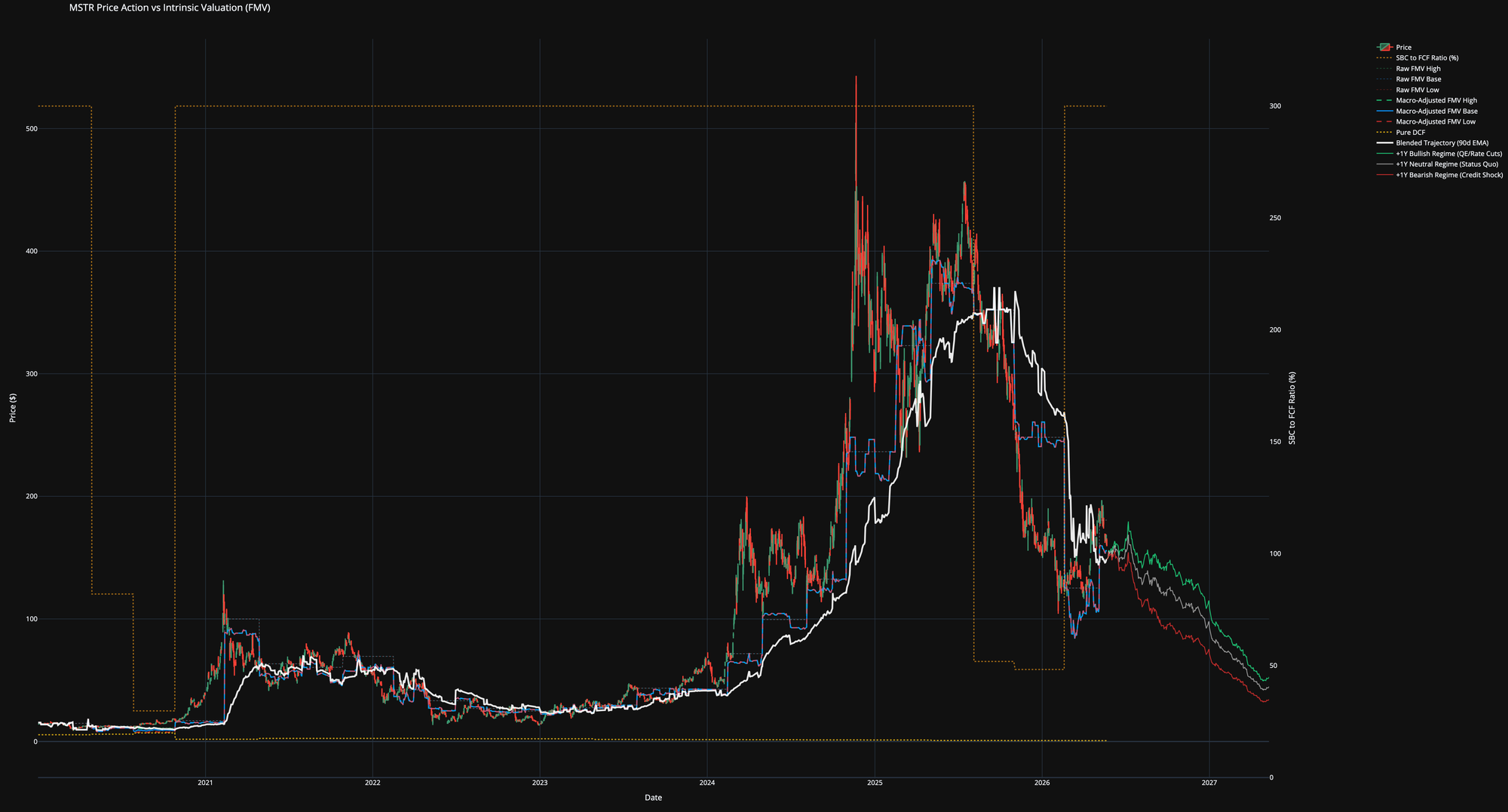
If you want to explore the complete mutation of a corporate equity, look no further than MicroStrategy. This ticker introduces an entirely different archetype of valuation comedy. It is the leveraged proxy hallucination.
MSTR
When running a strict Discounted Cash Flow analysis on MSTR, the math evaluates the legacy enterprise software business. To do this accurately, a strict exclusion filter must be applied to strip the Bitcoin treasury completely off the balance sheet, isolating the naked operating company. What remains is a small pool of legacy software assets and cash, weighed against roughly $8.6 billion in total liabilities consisting primarily of the convertible debt issued to buy the crypto.
If you calculate the pure liquidation value of this operating shell, the math is brutal. The legacy assets minus the massive debt load results in a deeply negative valuation of roughly -$18.00 per share. The operating business is fundamentally insolvent. However, because a corporate equity cannot legally trade below zero, the intrinsic model simply floors the negative output, resulting in a pure DCF line that violently drops and flatlines at absolute $0.00.
MSTR NAV
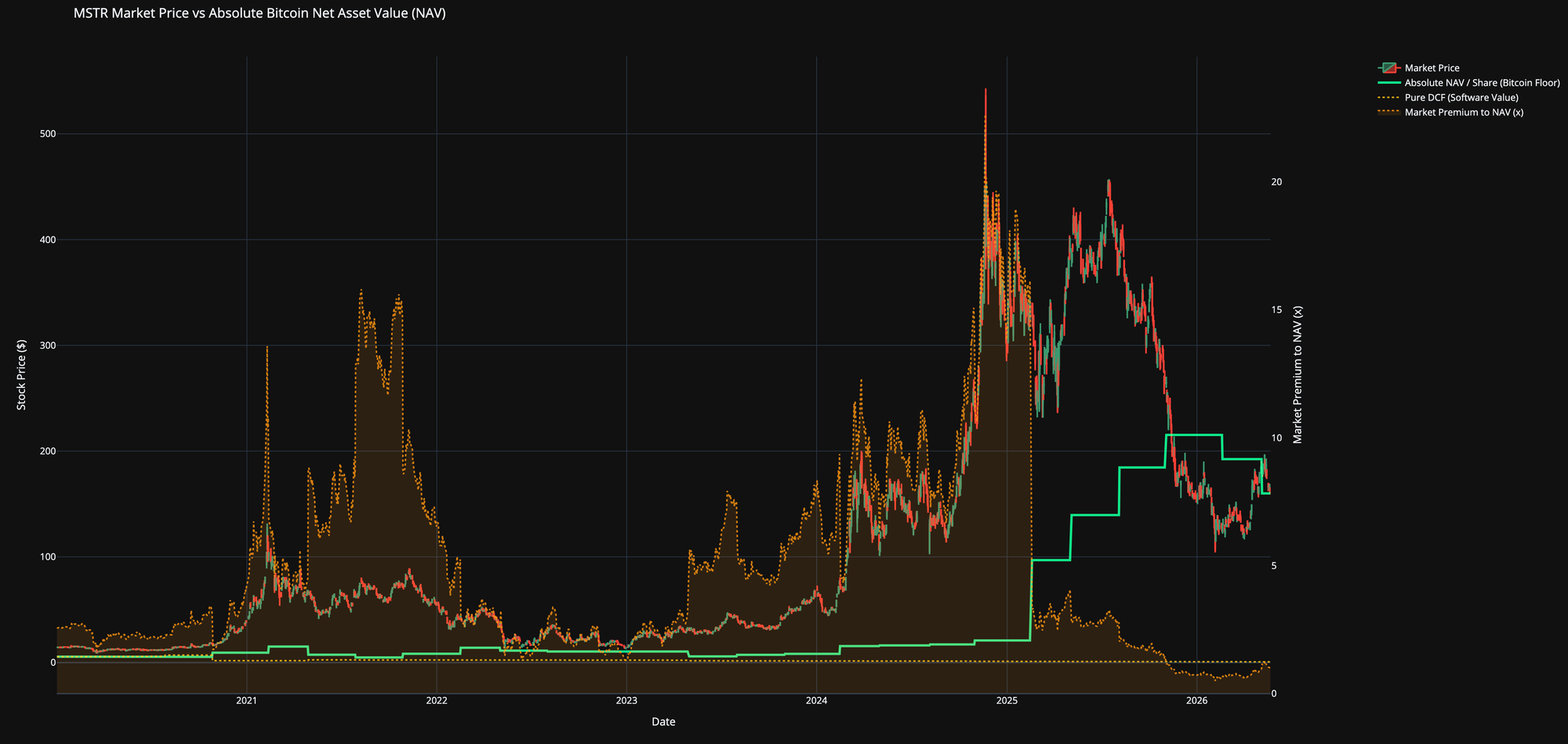
But the market stopped valuing MSTR as a software company years ago. It operates almost entirely as a leveraged Bitcoin acquisition vehicle. The true comedy here is not just that the stock price ignores its operating cash flow. The absurdity is that during periods of kinetic euphoria, the stock routinely trades at a massive, irrational premium to the actual Net Asset Value (NAV) of the Bitcoin sitting on its balance sheet. Retail and institutional investors willingly pay two to five times the actual Net Asset Value for a dollar of Bitcoin simply to hold it in a leveraged corporate wrapper.
The final trap lies in the liquidity illusion. It is tempting to look at the balance sheet, multiply the treasury count of roughly 843,738 Bitcoin by the live spot price, and calculate a one-to-one Fair Market Value. If you run the raw math, adding a $65 billion Bitcoin treasury to the cash reserves and subtracting the massive debt load, the output yields a seemingly pristine Fair Market Value of roughly $178.90 per share.
But this assumes infinite liquidity, which the market does not provide. If a single corporate entity holding over 840,000 Bitcoin were forced to liquidate, the order book depth does not exist to absorb it without catastrophic slippage. Algorithmic front-running and institutional discounting dictate that this $178.90 "Paper NAV" is a mirage. A mechanically sound valuation must target a "Realizable NAV" by applying a strict, structural haircut to the digital asset treasury before defining the fundamental floor.
This breaks every standard rule of fundamental engagement. Fading the asset simply because its software cash flows are dead is a guaranteed liquidation sentence. To survive this specific mutation, traditional valuation pipelines must be entirely bifurcated. The operating DCF must be discarded, and the focus must dynamically shift to tracking the market premium above the Realizable NAV floor. When the kinetic momentum of the underlying crypto market finally fractures, that massive proxy premium becomes the exact liquidity void the price action collapses into.
The Setup: The Illusion of Fundamental Gravity
The greatest trick the market plays is convincing developers that their models still work. Some assets will temporarily respect fundamental gravity. They will track along a macro-adjusted blended trajectory, perfectly responding to JIT (just-in-time) macro haircuts during liquidity shocks or quantitative easing tailwinds.
But this is just the setup. The moment an asset hits a catalyst, it violently ruptures the upper intrinsic ceilings and goes vertical. The fundamental step functions, constrained by quarterly earnings data, are simply too slow to react. They leave visual charts looking like a glitch in the rendering matrix, with the price action orbiting in a complete liquidity void miles above the highest fundamental projection.
The "Wrong-Way Wall Street" Mechanic
Surviving this comedy requires a structural pivot. Automated systems can no longer rely on intrinsic valuation ceilings as hard rejection constraints. If a system blindly shorts an asset simply because it is overvalued, it will be squeezed into liquidation.
Instead, the divergence itself becomes the alpha.
When an asset is trading at a massive premium to its fundamental consensus, but the kinetic momentum and options flow are pristine, the system must flip the script. It requires a "Wrong-Way Wall Street" mechanic. The engine must actively buy the analyst divergence, riding the liquidity vacuum until the exact moment the momentum dies.
The Post-Squeeze Reality
The comedy does have a dark ending. When an asset is suspended entirely by options order flow and dealer hedging, lacking any fundamental floor, the eventual mean reversion is violent.
The true value of the intrinsic model is not in calling the top. It is in measuring the distance of the fall. When the kinetic momentum finally craters and the liquidity void gives way, that massive gap between the $400 market price and the $100 fundamental baseline fills in a hurry. In this market, fundamental models do not dictate when to buy, but they absolutely dictate the severity of the post-squeeze collapse.
Field Log Discussion
Public @handle only · Private email hidden · Fenced code blocks supported
Join the architecture review under a self-chosen @handle. Your email address is never displayed publicly.
Related Field Logs

How to Fix the U.S. Economy: Solving the $40.7T National Debt, Breaking Inflation Into Gentle Deflation, and Unlocking Real Growth at Low Interest Rates
How gentle deflation, 100% reserves, and patching ultra-wealthy leverage crush the $40.7T debt, cut rates below 2%, and survive the coming AI job shock.

The $25 Billion Leveraged Cannibal: Agentforce, AI Venture Equity & Consensus Rate-Scenario Valuation of Salesforce ($CRM)
Ahead of Q3 FY27 earnings: DCF valuation of Salesforce ($CRM) across its historic $25B ASR, $66.3B RPO, $11.3B AI venture portfolio, Braze M&A, and +/-100bp rate shocks.

Why Quantitative Easing Is Now Imminent: Zero Reverse Repo, a -$321B Bank Reserve Deficit, and a $929B Six-Day Treasury Settlement Wall
With Reverse Repo 99.99% empty ($350M) and bank reserves -$321B below 10% of GDP, a $929B gross / +$176B net Treasury settlement wall makes Fed QE imminent.
Loading discussion notes...